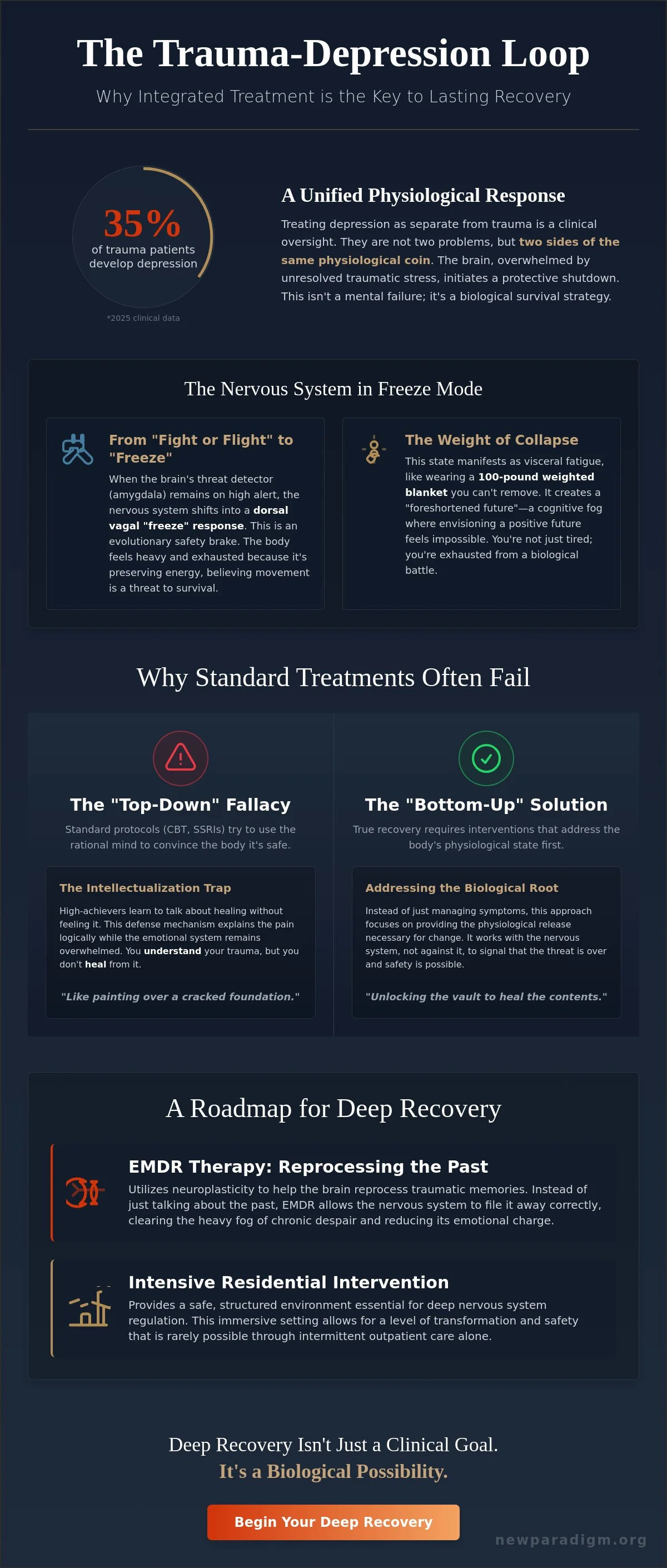
Treating your depression as a separate entity from your trauma isn't just inefficient; it's a clinical oversight that keeps you trapped in a cycle of relapse. You likely already understand the "why" behind your struggle. You've spent years in talk therapy dissecting your past, yet the heavy, visceral exhaustion of depression remains. It's frustrating to feel like a "difficult" or "treatment-resistant" patient when you're doing the work. The reality is that your body isn't failing you. It's simply protecting you. When we focus on treating trauma and depression together, we stop fighting the symptoms and start addressing the physiological root that affects over 35 percent of trauma patients according to 2025 clinical data.
You deserve a recovery that feels as deep as the pain you've carried. You aren't broken, and you haven't reached a dead end. In the following sections, we'll bridge the gap between clinical expertise and your lived experience. You'll discover why these two conditions are biologically intertwined and how a unified approach can finally quiet the internal noise. We'll provide a roadmap for integrated care that moves beyond intellectualizing your pain and toward a grounded, lasting sense of peace. Deep recovery isn't just a clinical goal. It's a biological possibility.
Key Takeaways
- Understand how your brain initiates a protective shutdown to manage the weight of unresolved traumatic memories.
- Identify why intellectualizing your pain in standard talk therapy often acts as a defense mechanism that prevents genuine healing.
- Learn why treating trauma and depression together is the only way to address the biological lock keeping your nervous system in a state of collapse.
- Discover how EMDR therapy sessions utilize neuroplasticity to reprocess the past and clear the heavy fog of chronic despair.
- Recognize the clinical value of an intensive, residential environment for achieving a transformation that isn't possible through outpatient care alone.
The Intertwined Architecture: Understanding Comorbid Trauma and Depression
Many clinical models view depression as a secondary symptom of post-traumatic stress. This is a fundamental mistake. In reality, Psychological trauma and depression are often two sides of the same physiological coin. When the brain is subjected to chronic, unresolved stress, it doesn't just feel sad; it enters a state of biological lockdown to preserve energy. This is why treating trauma and depression together is essential. You can't simply talk your way out of a survival response. Comorbid trauma and depression is a unified physiological response to overwhelming stress.
To better understand how these conditions are being addressed through modern clinical research, watch this report:
We must distinguish between situational sadness and trauma-induced clinical depression. Situational sadness is a natural response to external loss that typically resolves as you process the event. Trauma-induced depression is different. It's a structural change in how your brain processes safety and threat. It acts as a biological lock. The traumatic memory is the key, and the depressive state is the vault that keeps you from accessing the pain. Treating trauma and depression together allows us to unlock that vault safely.
The Nervous System in "Freeze" Mode
Your nervous system is designed to protect you. When the amygdala stays on high alert for too long, the body eventually reaches a breaking point. It shifts from "fight or flight" into a dorsal vagal response. This is the freeze mode. It isn't a lack of willpower. It's an evolutionary safety brake. You feel heavy because your body is trying to keep you safe. Snapping out of it is physiologically impossible because your brain believes movement is a threat to your survival.
Symptoms of the Trauma-Depression Loop
The fatigue of this loop isn't just tiredness. It's a visceral, internal collapse that feels like wearing a 100-pound weighted blanket you can never remove. High-achievers often experience a specific, painful type of isolation in this state. You might maintain a perfect career while feeling absolutely nothing inside. This cognitive fog makes it impossible to envision a future. Clinically, this is a "foreshortened future." It's the haunting sense that the fog will never lift. You aren't just tired; you're exhausted from pretending you aren't drowning.
Why Standard Depression Treatments Often Fail Trauma Survivors
Standard depression protocols often rely on a combination of Cognitive Behavioral Therapy (CBT) and SSRIs. While these tools have merit for some, they frequently fall short for those navigating the high comorbidity of PTSD and depression. This failure occurs because these methods are top-down. They attempt to use the rational mind to convince the body it's safe. If your nervous system is stuck in the freeze mode discussed earlier, logic isn't enough. Antidepressants might take the edge off the despair, but they rarely resolve the underlying trauma-based cycles that trigger the depression in the first place. Simply managing symptoms while the trauma remains active is like painting over a cracked foundation; the structural instability persists.
The "Intellectualization" Trap
For the high-achiever, therapy can become another performance. You've learned to speak the language of healing without actually experiencing it. This is intellectualization. It's a sophisticated defense mechanism where the logical prefrontal cortex creates a narrative to explain the pain while the emotional limbic system remains isolated and overwhelmed. You understand the "why," but you don't feel better. Standard therapy can inadvertently reinforce these trauma loops by ruminating on the past without providing the physiological release necessary for change. Understanding your trauma is a cognitive achievement; healing it is a biological one.
The Need for Bottom-Up Intervention
True recovery requires shifting the focus from the "talking" brain to the physical body. This is a bottom-up approach. Before the mind can release depressive thoughts, the body must feel a genuine sense of safety. Somatic and physiological interventions bypass the noise of the rational mind to address the trauma where it actually lives. This is a core component of a Residential Trauma Treatment Program. By treating trauma and depression together in an environment that prioritizes deep internal work, we move beyond superficial management toward true transformation. If you're ready to stop managing symptoms and start healing the source, you can speak with a clinical specialist today to explore a different path.
Integrated Modalities: Reprocessing the Past to Heal the Present
Recovery is not a performance; it is a physiological realignment. When we move beyond the limitations of talk therapy, we begin the work of clearing the biological residue that keeps you stuck. Treating trauma and depression together requires a clinical strategy that respects the brain's capacity for change while acknowledging the depth of your exhaustion. By utilizing neuroplasticity, we can rewire a brain that has been conditioned to live in a state of despair. This process isn't about forgetting the past. It's about changing how your body remembers it.
Reprocessing a single, pivotal traumatic event often has a cascading effect on your mental health. You might find that once the emotional charge of a specific memory is neutralized, a whole cluster of depressive symptoms begins to lift. This happens because the brain finally receives the signal that the threat has passed. Research into intensive trauma-focused treatment demonstrates that this integrated approach is significantly more effective than treating symptoms in isolation. You aren't just lifting a mood; you're resolving a survival response.
The Clinical Power of EMDR
EMDR therapy sessions are a cornerstone of this integrated approach. Through bilateral stimulation, we help the brain move stuck memories from the reactive limbic system to the more stable parts of the cortex. This process desensitizes the visceral pain associated with your history, often working faster than traditional methods for complex, comorbid cases. It allows you to observe your past without being consumed by it. For a deeper look at the mechanism of this work, you can read our EMDR Therapy Sessions: A Clinical Guide.
Holistic Stabilization Techniques
Clinical reprocessing is only one half of the equation. To sustain recovery, you must repair a depleted system through grounding practices and physiological support. This includes a focus on three core pillars: sleep hygiene, nutritional support, and nervous system regulation. We incorporate mindfulness and contemplative traditions not as mere relaxation tools, but as essential methods for internal stabilization. You will build a practical toolkit for emotional regulation that stays with you long after you leave the clinical environment. If you are ready to begin this process of deep realignment, reach out to our clinical intake team for a confidential consultation.
The Case for Intensive, Residential Intervention
Treating trauma and depression together is not a task that can be relegated to the margins of a busy life. For many high-achievers, the attempt to heal while maintaining professional responsibilities only deepens the cycle of exhaustion. You cannot expect your nervous system to fully down-regulate when you're still surrounded by the same triggers that keep you in a state of high alert. Residential care isn't a luxury. It's a clinical necessity for those whose depressive "freeze" response has become a chronic, structural part of their existence. True transformation requires a level of focus that outpatient care simply cannot provide.
At New Paradigm, we understand that deep recovery happens in the spaces between sessions. It happens in the 24/7 clinical support of a private, supportive environment where you're finally safe to let the mask of "having it all" slip away. We offer a strictly limited and intentional capacity to ensure that your recovery is the primary focus of our clinical team. This environment allows for the intensive, internal work that is required to move beyond symptom management and toward a genuine physiological shift.
Removing the "Noise" of Daily Life
Professional and personal triggers act as constant static, preventing your brain from entering the state of calm required for reprocessing. Isolation from external stress isn't about avoidance; it's about creating a clinical vacuum where your nervous system can finally rest. The physical environment of Chiang Mai contributes to this process, offering a spiritual calm and a sense of peace that is essential for grounding. This geographic distance provides the literal and metaphorical space needed to confront deep-seated pain. For more on why this location is vital to the process, see our Mental Health Facility Thailand: A Clinical Guide.
A Compassionate Realist Approach to Aftercare
The most critical phase of recovery isn't the breakthrough you have in a session; it's the transition back to your life. We are compassionate realists. We know that the world hasn't changed while you were away, so you must return with a different internal architecture. A structured Aftercare Program is the critical bridge that prevents relapse by reinforcing your new toolkit for emotional regulation. You don't have to navigate the weight of your past alone. If you're ready to move beyond intellectualized pain and experience a recovery that lasts, you can begin your journey at New Paradigm today.
Reclaiming Your Life Through Integrated Care
The path to recovery is not found in managing symptoms or intellectualizing your history. It is found in the decision to address the biological roots of your pain. We've explored how the nervous system enters a state of collapse and why top-down therapies often fail to reach the somatic depths where trauma resides. By treating trauma and depression together as a single physiological unit, you can finally move beyond the freeze response that has defined your existence. Recovery is not a matter of willpower. It's a matter of providing your body with the right clinical environment to heal.
New Paradigm offers a path toward this deep internal transformation. As a privately owned boutique clinical facility, we maintain a strictly limited capacity to ensure highly personalized, intensive care for every individual. Our specialized EMDR therapy, led by experienced clinicians, is designed to reprocess the past and clear the depressive fog. You don't have to carry the weight of hidden exhaustion alone. If you're ready to step into a grounded, lasting recovery, we invite you to Explore our Residential Trauma Treatment Program in Chiang Mai. There is a version of your life where you feel connected, present, and at peace.
Frequently Asked Questions
Can trauma cause clinical depression years after the event?
Yes, trauma often manifests as clinical depression years or even decades after the initial experience. For high-achievers, success often serves as a functional mask that eventually wears thin. When the nervous system can no longer sustain the effort of holding it all together, it may collapse into a depressive shutdown. This isn't a new problem; it's the body finally demanding that the old architecture be addressed.
Is EMDR therapy effective for treating depression if I don't have PTSD?
EMDR therapy is a powerful tool for depression, regardless of whether you meet the full criteria for PTSD. Many depressive episodes are fueled by unprocessed life experiences that remain stuck in the limbic system. By neutralizing the emotional charge of these memories, EMDR allows the brain to exit the despair loop. It's about clearing the biological static that keeps you from feeling present and alive.
What is the difference between burnout and trauma-induced depression?
Burnout is often tied to external depletion, while trauma-induced depression is an internal survival response. While they look similar, burnout usually resolves with rest. Trauma-induced depression does not. If your exhaustion persists despite taking time away, you're likely dealing with a deeper physiological lock. Treating trauma and depression together ensures that you aren't just resting, but actually repairing the nervous system's capacity for resilience.
How long does an intensive residential trauma program typically last?
A typical stay in a residential trauma program lasts between 30 and 90 days. This timeframe allows for the deep, internal work that outpatient sessions cannot accommodate. It takes time for the body to feel safe enough to release long-held survival patterns. This period isn't a luxury; it's a dedicated window for intensive reprocessing and the stabilization of new, healthy neural pathways.
Can I treat trauma and depression together without medication?
Medication is not always a requirement for successful recovery. While pharmaceuticals can manage symptoms, they don't resolve the underlying traumatic memories stored in the body. By treating trauma and depression together through somatic work and EMDR, many individuals find they can regulate their nervous systems naturally. We focus on biological realignment rather than chemical suppression to achieve a deep, sustainable sense of internal peace.
Why does my depression feel worse when I start talking about my trauma?
Depression can feel more intense during talk therapy because the brain is being asked to revisit pain without the tools to process it. This re-activation can feel like drowning in old emotions. Without somatic grounding, your nervous system perceives the memory as a current threat and triggers a deeper shutdown to protect you. This is why we prioritize physiological safety before diving into traumatic narratives.

Article by
Dirk J. Lambert (MSc. - CCTS-I)
Dirk J. Lambert is a Licensed Psychotherapist, Mentor, Author, and Certified Trauma & EMDR Specialist with more than 25 years of experience helping people recover from trauma, depression, burnout, emotional abuse, and long-standing unresolved pain. His work is known for being direct, compassionate, and highly practical.
A twice-ordained Buddhist monk, Dirk bridges clinical trauma care with mindfulness, discipline, self-observation, and deep emotional honesty. He does not hide behind jargon, labels, or unnecessary complexity. He listens carefully, speaks plainly, and works toward meaningful change.
New Paradigm reflects the philosophy he has built over decades: intentionally small, deeply personal, private by design, and focused on what actually helps people recover from the inside out rather than simply cope more elegantly.