What if the reason you feel stuck isn't a lack of insight, but a physiological stalemate within your own body? You've spent years in 50-minute sessions, dissecting every memory and mapping out your history with clinical precision. Yet, despite your outward success and intellectual mastery of your past, that visceral weight of exhaustion remains. You understand your trauma, but you haven't yet felt it leave you. It's a frustrating, quiet realization to discover that when talk therapy isn't enough for trauma, the mind is simply speaking a language the nervous system cannot hear.
You aren't failing at your recovery. It's not a lack of will, a lack of intelligence, or a lack of effort; you've simply reached the natural limits of a top-down approach. This article provides a physiological explanation for that persistent sense of being stuck and introduces evidence-based alternatives that move beyond the intellect. You'll discover how shifting your focus from logic to the body's safety can unlock a path to deep, internal transformation and the lasting recovery you deserve.
Key Takeaways
- Understand the intellectualization trap, where your mind uses logic to bypass emotional pain and creates a barrier to true healing.
- Discover why the nervous system remains dysregulated when talk therapy isn't enough for trauma, and how "Bottom-Up" therapies target the brain's subcortical regions.
- Identify the subtle signs of a recovery plateau, including hidden exhaustion and the "revolving door" of weekly therapy that lacks significant progress.
- Learn how a Residential Trauma Treatment Program offers the protective environment and intensive focus required for deep psychological recovery.
- Gain insight into the physiological reality of trauma as a state of the nervous system rather than just a collection of memories.
The Intellectualization Trap: Why Talking About Trauma Isn’t Always Healing It
For many high-achieving individuals, the mind is a highly developed tool used to navigate complex problems and manage crises. In the context of trauma, however, this same brilliance can become a sophisticated cage. The intellectualization trap occurs when you use logic, analysis, and storytelling to bypass the raw emotional pain stored in your body. You can explain your history with clinical precision, yet your heart still races at night and your body feels perpetually braced for impact. You've learned to talk about the fire without ever feeling the heat. This is precisely why when talk therapy isn't enough for trauma, the solution rarely lies in more talking.
To better understand why verbal processing has its limits, watch this helpful video:
The Limits of the Prefrontal Cortex in Trauma Recovery
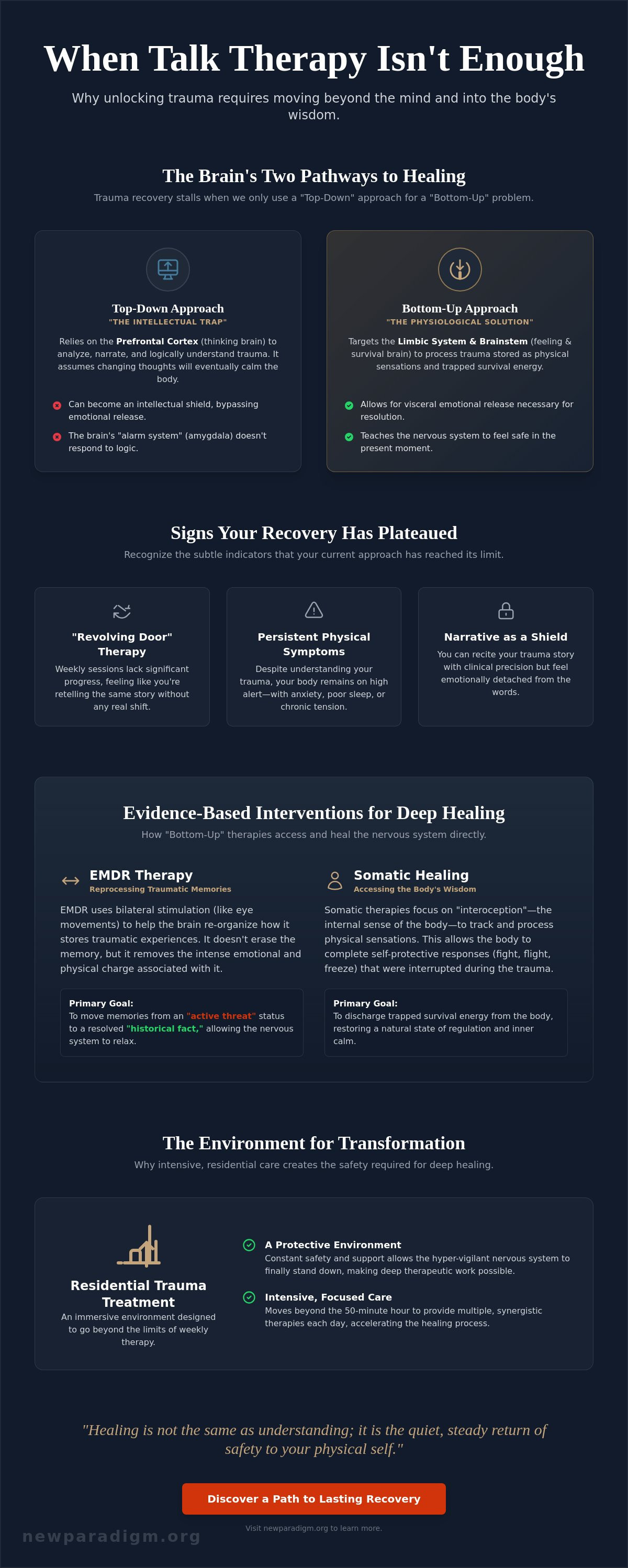
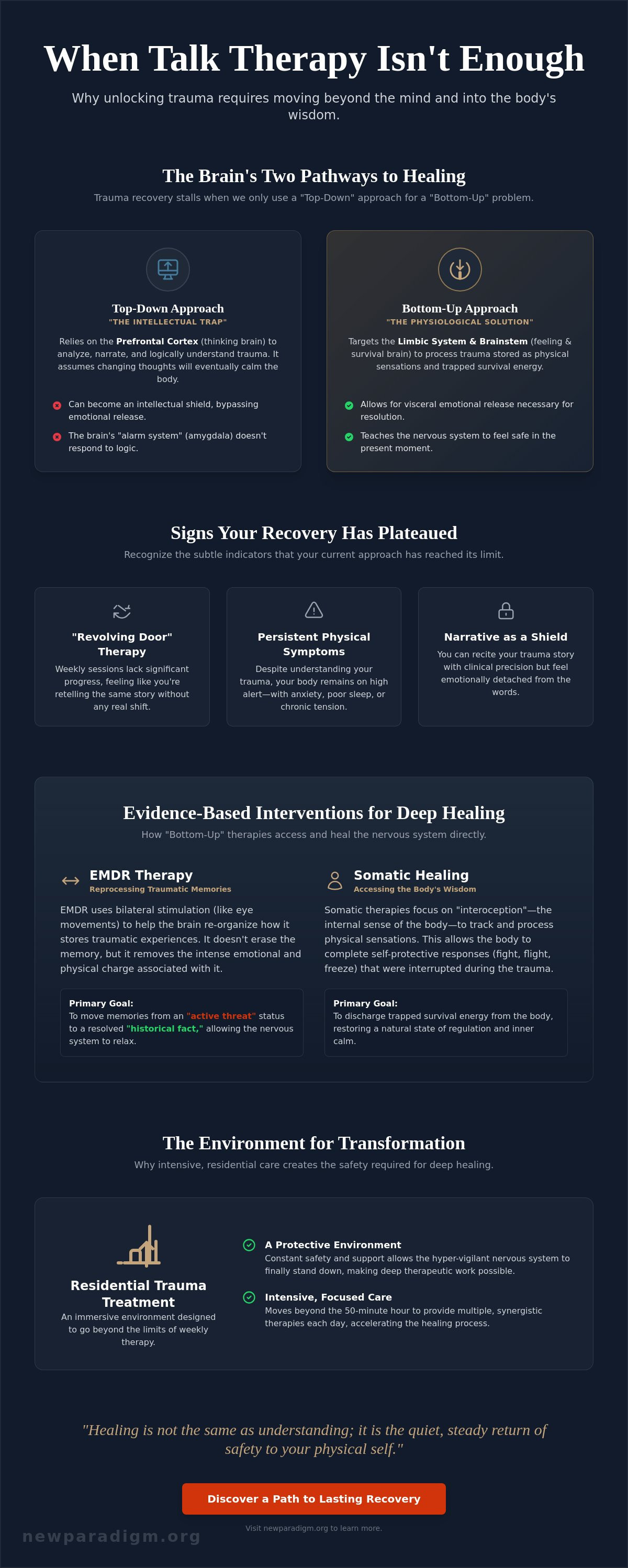
Traditional psychotherapy often relies on a top-down approach. It assumes that by changing your thoughts in the prefrontal cortex, you can eventually calm the deeper, more primitive parts of your brain. But the amygdala, the brain's alarm system, does not speak in words. It speaks in sensations, heart rates, and muscle tension. When you are in a state of hyper-arousal, the thinking brain often goes offline, making it impossible to reason your way into peace. A cognitive bypass is a common hurdle where high-achievers use their intellect to avoid the vulnerability of their own physiology. While models like Somatic Experiencing suggest that we must work with the body's felt sense, pure talk therapy often leaves the subcortical regions of the brain untouched.
When Your Story Becomes a Shield
Reciting your trauma narrative can eventually become a form of defense. If you've told your story dozens of times, the words can lose their emotional weight. Your narrative becomes a script that keeps you detached from the actual experience. This intellectualized pain allows you to stay in control, but it prevents the visceral emotional release necessary for true resolution. Your therapy has become an academic exercise when you notice that you can discuss your deepest wounds without any change in your breathing or posture. You are observing your life from a distance rather than living it from within. Healing is not the same as understanding; it is the quiet, steady return of safety to your physical self.
Trauma in the Nervous System: The Case for Somatic and EMDR Interventions
Trauma is not a story you tell; it's a physiological event that the body continues to live in the present. While the mind may have processed the facts of the past, the nervous system often remains trapped in a state of high alert or profound collapse. This biological reality explains why when talk therapy isn't enough for trauma, we must look toward bottom-up interventions. These therapies bypass the prefrontal cortex to target the subcortical regions, where the survival instincts of the brainstem and limbic system reside. Healing requires more than conversation. It requires the discharge of trapped survival energy, such as fight, flight, or freeze responses, that have become stagnant in your physical self.
How EMDR Reprocesses Beyond the Verbal
Traditional methods often struggle to reach the core of traumatic triggers. Eye Movement Desensitization and Reprocessing (EMDR) therapy uses bilateral stimulation to help the brain re-organize how it stores these experiences. During EMDR therapy sessions, the brain is guided to move memories from an active threat status to a historical fact status. This shift allows the amygdala to stop sounding the alarm for events that are long over. It's often the definitive turning point for individuals who feel they've hit a ceiling in their recovery journey through standard outpatient care.
Somatic Healing: Accessing the Body's Wisdom
True transformation involves interoception, which is the internal ability to feel and interpret bodily sensations. Trauma often severs this connection, leading to a sense of being all in your head while the body remains exhausted or numb. Somatic techniques help expand your window of tolerance, allowing you to process intense emotions without becoming overwhelmed or shutting down. When the nervous system finally feels a sense of physiological safety, the mind can let go of its defensive narratives. If you find yourself needing more than just a weekly check-in to find this peace, you might consider reaching out to speak with a clinical professional about a more intensive path. By addressing the body's wisdom, you move beyond mere management and into the space of genuine, internal resolution.
Signs Your Recovery Has Plateaued: When to Seek Intensive Support
Recognizing that you've reached a plateau is a difficult, yet essential, step toward genuine healing. You may find yourself in a "revolving door" of weekly sessions where you discuss the same triggers, analyze the same patterns, and yet leave feeling fundamentally unchanged. It's a quiet, heavy frustration. You have the insight. You have the vocabulary. But the symptoms persist. This is the moment when you must acknowledge that when talk therapy isn't enough for trauma, the standard outpatient model may no longer be the right fit for your nervous system's needs.
The signs of a plateau often manifest physically before they are acknowledged mentally. It is not a failure of will; it is a signal from a body that is overtaxed. You might experience:
- Chronic, pervasive fatigue that no amount of rest seems to touch.
- Unexplained physical pain or a constant, visceral sense of internal collapse.
- A growing inability for standard "coping skills" to manage the intensity of flashbacks or dissociation.
- A stark disconnect between your outward professional success and a private, desperate struggle for emotional stability.
The Limitation of the 'Therapy Hour'
The traditional 50-minute session is often too brief to address deep-seated, complex trauma. There is a recurring "opening and closing" problem. You spend twenty minutes grounding yourself to begin, twenty minutes touching a wound, and the final ten minutes rushing to compose yourself before driving home to face your responsibilities. This cycle can inadvertently reinforce trauma by leaving you raw and unsupported in the outside world. Intensive, daily intervention is not a luxury. It is a necessary container that breaks this cycle of reinforcement, providing the time required for the nervous system to actually shift.
Emotional Burnout and the High-Achiever
High-functioning individuals are often the most adept at masking their internal collapse. You've likely spent years "powering through" your history, using your career as a shield against your pain. However, this endurance has a cost. Many high-achievers don't realize they need a burnout recovery program until their system reaches a state of total exhaustion. True strength is not found in further endurance. It is found in the willingness to step out of the noise and into a dedicated environment designed for deep work. If your current path has stalled, you can reach out to discuss an intensive treatment plan that honors the gravity of your experience and provides a clear path forward.
Beyond the Therapy Hour: The Case for Residential Trauma Treatment
Environment is not merely a backdrop for healing; it is an active participant in the process. For many, the realization that when talk therapy isn't enough for trauma leads to the understanding that recovery cannot occur in the same environment where the stress is maintained. You cannot expect a nervous system to down-regulate while it remains immersed in the noise of professional demands, family expectations, and the subtle triggers of daily life. A Residential Trauma Treatment Program serves as a protective container, providing the sanctuary required for intensive, uninterrupted internal work. By removing the external noise, you create the space for the body to finally speak and for the mind to finally listen.
This approach combines rigorous clinical methodology with the restorative calm of intentional locations like Chiang Mai. It is a transition from mere crisis management to the construction of a sustainable life. True recovery is not just about the time spent in treatment; it is about how that healing is integrated into your future. A structured aftercare program provides the critical bridge, ensuring that the physiological shifts achieved during your stay remain resilient against the pressures of the world you eventually return to.
Why Environment Matters: The New Paradigm Approach
Deep psychological recovery requires isolation from the triggers that keep your system in a state of hyper-vigilance. Our model is not a general wellness retreat. It is a personal environment for intensive internal work, built on the "Compassionate Realist" philosophy where clinical excellence meets contemplative peace. We prioritize depth over scale. By maintaining an extremely limited and intentional capacity, we ensure that your care is never diluted. This boutique setting allows for a level of focus and clinical precision that is simply not possible in larger, more clinical institutions.
Transitioning to Intensive Healing
Moving from a plateau to a breakthrough requires a deliberate shift in strategy. If you feel ready to move beyond intellectual understanding and into visceral resolution, consider these steps:
- Acknowledge the limit: Recognize that your current outpatient model has provided what it can, and that your continued "stuckness" is a physiological signal for more intensive care.
- Prioritize the somatic: Research evidence-based residential facilities that move beyond talk therapy to prioritize nervous system regulation and somatic processing.
- Commit to focus: Give yourself permission to step away from daily responsibilities for a dedicated period of deep, uninterrupted healing.
Your recovery is not a project to be managed in the margins of a busy life. It is the foundation upon which everything else is built. If you are ready to explore a path that honors the complexity of your experience, we invite you to explore our residential recovery path at New Paradigm. Here, we do not offer superficial management; we provide the practical methodology for navigating through the depths of struggle into a state of grounded, lasting peace.
Reclaiming Your Physiological Peace
Healing is not a matter of logic. It is a matter of biology. You have spent enough time analyzing the "why" of your suffering; it's now time to address the "how" of your recovery. Recognizing when talk therapy isn't enough for trauma is the first step toward a more profound, integrated resolution. By shifting from top-down analysis to bottom-up physiological safety, you allow your nervous system to finally release the exhaustion and internal collapse that have defined your private struggle for so long. Insight alone cannot quiet a dysregulated body.
At New Paradigm, we provide a private, boutique clinical environment in Chiang Mai designed specifically for this intensive work. Our approach combines decades of clinical expertise in complex trauma with evidence-based EMDR and Somatic interventions. We don't offer temporary management or superficial coping skills; we offer a practical methodology for navigating through the depths of human struggle. You can begin your journey to deep recovery at New Paradigm today. True resolution is possible when you choose an environment that honors both your complexity and your inherent capacity for lasting change.
Frequently Asked Questions
Why do I feel worse after talking about my trauma in therapy?
You likely feel worse because verbal processing can inadvertently re-traumatize the nervous system. When you recount a painful memory without the physiological tools to regulate your body's response, you're essentially re-living the threat. This leads to a state of hyper-vigilance or emotional flooding that persists long after the 50-minute session ends.
True healing requires more than just opening the wound; it requires a safe way to stitch it back up. Without somatic grounding, talking about the past just keeps the survival energy trapped in your body, leading to the exhaustion and "stuckness" many high-achievers experience.
Is EMDR better than talk therapy for Complex PTSD?
EMDR is often more effective for Complex PTSD because it targets how the brain stores traumatic memories rather than just the story itself. While talk therapy addresses the "top-down" narrative, EMDR works from the subcortical brain to desensitize the physiological triggers. It's a critical tool to utilize when talk therapy isn't enough for trauma.
By moving memories from an active threat status to a historical fact, EMDR allows the amygdala to finally stand down. This shift is often the turning point for those who have spent years in traditional therapy without significant symptom reduction.
How do I know if I need a residential trauma treatment program?
You should consider a residential program when your symptoms interfere with your daily functioning despite consistent outpatient sessions. If you find yourself in a "revolving door" of weekly therapy where you never feel truly stable, you likely need a more intensive container. This is especially true for those who mask their struggle with outward professional success.
Residential care provides isolation from external noise and triggers. It allows you to focus entirely on your nervous system without the pressure of driving home or managing responsibilities immediately after a difficult session.
What is 'Bottom-Up' therapy and why does it matter for trauma?
Bottom-up therapy refers to interventions that prioritize the body's sensations and nervous system state over cognitive analysis. It matters because the parts of the brain that control the trauma response do not speak in words. They respond to rhythm, breath, and physical safety.
While traditional therapy tries to use the mind to fix the body, bottom-up therapy uses the body to calm the mind. This approach is essential for discharging the "fight, flight, or freeze" energy that remains stagnant in the system long after the traumatic event has ended.
Can I recover from years of trauma in just a few weeks of intensive treatment?
Recovery is an ongoing process, but an intensive program acts as a powerful catalyst for profound change. A few weeks of focused, daily work can achieve shifts in the nervous system that might take years in a standard weekly model. It provides the immersion required to break through deep-seated plateaus.
This intensive period isn't a "quick fix," but rather a way to move from a state of survival into a state of sustainable stability. It sets the foundation for a life defined by peace rather than perpetual crisis management.
What should I do if my current therapist says talk therapy is the only way?
It's important to trust your own intuition and your body's signals. If your current approach isn't yielding measurable progress, seeking a second opinion from a practitioner trained in somatic or neurobiological modalities is a responsible step. Clinical excellence should always be balanced with an understanding of the body's unique needs.
Many talented therapists are simply not trained in the bottom-up techniques required for deep trauma work. Acknowledging that you need a different level of care is a sign of strength and a commitment to your own internal resolution.

Article by
Dirk J. Lambert (MSc. - CCTS-I)
Dirk J. Lambert is a Licensed Psychotherapist, Mentor, Author, and Certified Trauma & EMDR Specialist with more than 25 years of experience helping people recover from trauma, depression, burnout, emotional abuse, and long-standing unresolved pain. His work is known for being direct, compassionate, and highly practical.
A twice-ordained Buddhist monk, Dirk bridges clinical trauma care with mindfulness, discipline, self-observation, and deep emotional honesty. He does not hide behind jargon, labels, or unnecessary complexity. He listens carefully, speaks plainly, and works toward meaningful change.
New Paradigm reflects the philosophy he has built over decades: intentionally small, deeply personal, private by design, and focused on what actually helps people recover from the inside out rather than simply cope more elegantly.