If you have survived a traumatic event, you may have noticed something that does not make logical sense. You know, intellectually, that the event is over. It happened months or years ago. You are in a different place, a different room, sometimes a different country. And yet something - a smell, a sound, a shift in the light - can pull you back into it with a vividness that feels completely real. Your heart rate rises. Your body braces. The fear is not a memory. It is happening, right now, in the present tense.
This is one of the most distressing and disorienting aspects of trauma. And it is also one of the most common questions survivors ask: why does this keep happening? Why does it feel so real? Why does time not seem to help?
The answer lies not in weakness, not in a failure to move on, but in the biology of how the brain and body store traumatic experience - and why that storage system resists ordinary resolution. Military veterans know this pattern well; our combat PTSD retreat is built around it.
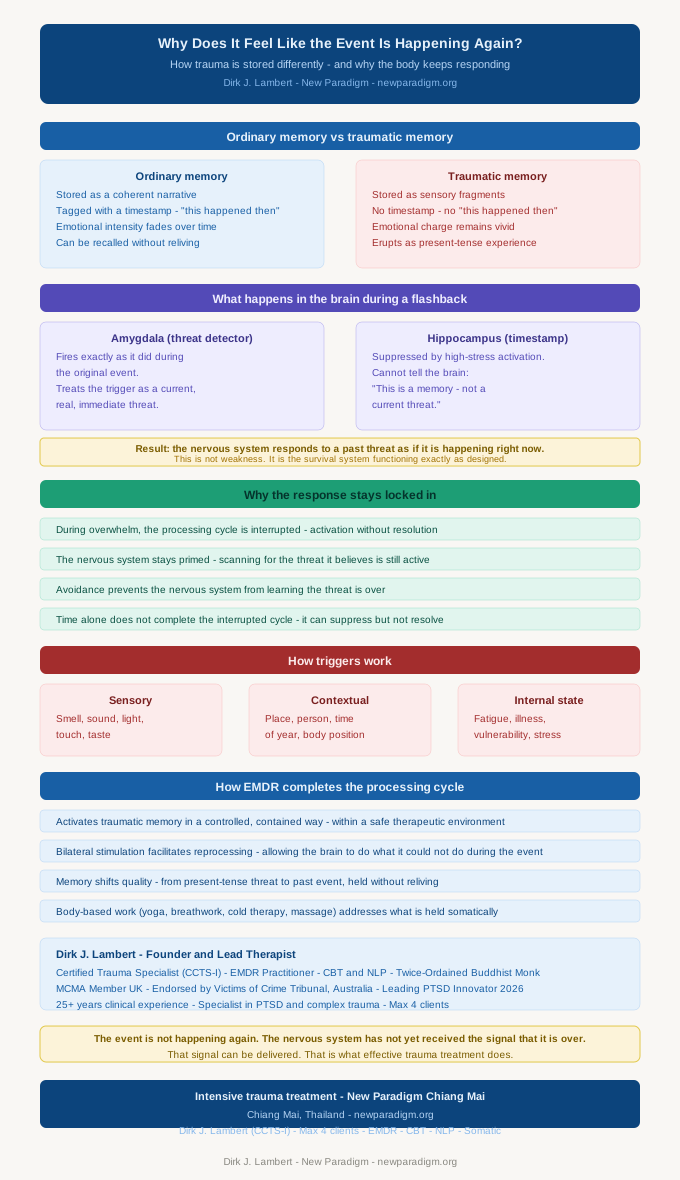
Ordinary Memory and Traumatic Memory Are Not the Same Thing
Most memories follow a predictable path. Something happens. The brain encodes it as a narrative - a story with a beginning, middle and end, tagged with a timestamp that places it firmly in the past. Over time, the memory consolidates, loses its emotional intensity, and becomes something you can think about without reliving.
Trauma does something different. During an overwhelming event - one that exceeds the nervous system's capacity to process it in real time - the brain's normal encoding process breaks down. The event gets stored not as a coherent narrative but as fragments: sensory impressions, physical sensations, emotional states, images. And crucially, these fragments are stored without the timestamp that would tell the brain: this happened then. It is not happening now.
This is why a flashback does not feel like a memory. It is not retrieved the way ordinary memories are. It erupts - unbidden, uncontrolled, and indistinguishable from present-moment experience. The nervous system is not playing back a recording. It is re-running a survival response.
What Happens in the Brain During a Flashback
Two brain structures are central to understanding why trauma responses feel so relentlessly present.
The amygdala is the brain's threat-detection system. It operates fast, below conscious awareness, and its primary function is survival. When it detects something that resembles a past threat - a tone of voice, a particular smell, a physical sensation - it fires an alarm. That alarm triggers the same cascade of physiological responses that occurred during the original event: adrenaline, cortisol, elevated heart rate, muscle tension, the urge to flee or freeze.
The hippocampus is responsible for contextualising memory - for placing experiences in time and space and distinguishing past from present. Under normal circumstances, the hippocampus is what allows you to recall a difficult experience and simultaneously know that it is over. During high stress and overwhelm, however, hippocampal function is suppressed. The amygdala essentially overrides it.
This means that when a trauma survivor encounters a trigger, the amygdala fires exactly as it did during the original event - but the hippocampus is not online to say: this is a memory, not a threat. The body mobilises its full survival response. The fear is not proportionate to the present moment because the brain is not responding to the present moment. It is responding to a threat it perceives as current, immediate, and real.
The Body Keeps the Record
Trauma is not stored only in the mind. It is encoded in the body - in muscle tension, breathing patterns, postural habits, the way the autonomic nervous system is calibrated to respond to signals of danger. This is why trauma responses can be triggered through the body as much as through thought or image.
The nervous system operates on pattern recognition. It is constantly scanning for signals that match previous threats. When it finds a match - even a partial one - it responds as if the original threat is present. This is not a psychological failure. It is the survival system doing exactly what it was designed to do. In an environment of ongoing danger, this level of vigilance would be protective. In ordinary civilian life, long after the event, it becomes exhausting and disruptive.
What survivors often experience as an inability to move on is, at the neurological level, a nervous system that has not yet received the signal that the threat is over. The survival response is locked in place, waiting for a resolution that ordinary time does not provide.
Why Time Alone Does Not Heal Trauma
There is a common expectation that time heals all wounds, including psychological ones. For many ordinary difficulties, this is roughly true. But trauma is different - and understanding why matters.
Time allows the mind to habituate to many difficult experiences. But habituation requires that the nervous system is able to process the experience - to move it through the threat-response cycle, from activation through to resolution. When an experience is too overwhelming to be processed in real time, that cycle is interrupted. The activation remains incomplete. The nervous system stays primed.
Simply waiting for time to pass does not complete the interrupted cycle. What it can do is suppress the response - through avoidance, through numbing, through the management strategies survivors develop to get through the day. But suppression is not resolution. The unprocessed material remains, and it continues to surface when something in the environment matches the threat signature the nervous system is holding.
This is why many people report that trauma symptoms do not simply fade but remain roughly constant for years, or even intensify during periods of stress or transition. The nervous system is not forgetting. It is waiting.
What Triggers a Flashback
Triggers are not random. They are sensory or contextual elements that carry a resemblance - often partial, sometimes subtle - to aspects of the original traumatic event. A particular quality of light. The sound of a raised voice. A certain body position. The smell of a specific place. Even internal states - fatigue, physical illness, emotional vulnerability - can match the internal conditions present during the original event and activate the survival response.
Because trauma is stored as sensory fragments rather than coherent narrative, the triggers can be difficult to identify. Survivors sometimes experience intense activation without any clear understanding of what set it off. The reaction seems to come from nowhere. This can add to the sense of being out of control - the sense that the past has a grip on the present that cannot be reasoned with or predicted.
Understanding that triggers are neurological - not emotional weakness, not failure to cope - is often an important early step in treatment. The response is not disproportionate given what the nervous system believes is happening. It is precisely proportionate to a threat the nervous system is still treating as present.
The Role of Avoidance
One of the most natural responses to something that causes intense distress is to avoid it. Survivors of trauma develop avoidance strategies - sometimes conscious, sometimes not - around the people, places, situations and internal states that activate their trauma response. Avoidance reduces short-term distress. It is also one of the primary factors that maintains trauma symptoms over time.
When the nervous system is not given the opportunity to encounter the feared stimulus in a safe context - to discover that the trigger does not actually lead to the threat - the association between trigger and survival response is never updated. The alarm remains calibrated to the same level. Avoidance prevents the nervous system from learning what it needs to learn to begin to settle.
This is not a moral failing or a character defect. It is an entirely understandable response to an experience that caused real harm. But it is one of the reasons why trauma does not resolve on its own, and why effective treatment involves, carefully and with appropriate support, moving toward rather than away from what has been avoided.
How EMDR Addresses the Locked Survival Response
Eye Movement Desensitisation and Reprocessing - EMDR - was developed specifically to address the way traumatic memory is stored differently from ordinary memory. Rather than requiring the survivor to talk through and analyse the event in detail, EMDR works by activating the traumatic memory in a controlled, contained way while simultaneously engaging bilateral stimulation - typically eye movements - that appears to facilitate the brain's own reprocessing mechanisms.
The clinical understanding is that bilateral stimulation activates a process similar to what occurs during REM sleep, when the brain ordinarily consolidates and reprocesses emotional experiences. EMDR essentially allows the brain to do what it could not do during the original overwhelming event - to move the experience through the processing cycle and encode it as something that happened, rather than something that is still happening.
When EMDR works, survivors often report a qualitative shift in how the memory feels. The images become less vivid. The emotional charge drops. The body no longer responds to the memory as if it is a present-tense threat. The event takes on the quality of ordinary memory - something that occurred, that can be recalled without reliving, and that has a clear relationship to the past rather than the present.
Understanding how childhood trauma shapes adult relational patterns offers further context for why unresolved traumatic memory has such wide-ranging effects - reaching well beyond the specific triggering situations into how a person relates to themselves and others across every area of life.
What This Means in an Intensive Treatment Setting
In an outpatient setting, trauma treatment typically happens in one-hour sessions once a week. The nervous system activates, is partially worked with, and then the client returns to ordinary life - often before the processing cycle has been completed. The therapeutic window is narrow.
In an intensive residential programme like New Paradigm, the structure is fundamentally different. With approximately 50 hours of treatment per week across a 14-day programme, the nervous system has the time and the sustained support to complete cycles of activation and resolution that a weekly session simply cannot accommodate. The body-based practices - yoga, breathwork, Thai massage, martial arts, sauna and cold therapy - are not supplementary. They are addressing the same locked survival responses at the level at which they are held: in the body.
Understanding what conditions intensive residential treatment works best for helps to clarify whether this level of intervention is appropriate - and for trauma specifically, the density of therapeutic contact is often what makes the difference between management and genuine resolution. What survivors can realistically expect from a 14-day intensive programme, day by day, is a question worth exploring before arriving - because the arc of recovery within a residential setting follows its own pattern, and understanding it in advance makes the process less disorienting.
If what you are experiencing - the intrusive memories, the flashbacks, the sense of a past that will not stay past - has not responded to time or to previous attempts at treatment, the question worth asking is not whether you are broken. It is whether the treatment approach you have tried has been intensive enough to address what is held in the body, not just what can be spoken about in a session.
Contact New Paradigm to have a confidential conversation about whether an intensive trauma programme is appropriate for your situation.
About the Author
Dirk J. Lambert is the founder and lead therapist at New Paradigm, a private mental health retreat in Chiang Mai, Thailand. He is a Certified Trauma Specialist (CCTS-I), EMDR practitioner, CBT and NLP specialist, and twice-ordained Buddhist monk with more than 25 years of clinical experience working with complex trauma, PTSD, depression, and attachment disorders. Dirk founded Thailand's first alternative recovery centre in 2000 and established New Paradigm in 2014. He is a recognised specialist in the treatment of sexual abuse survivors, an endorsed provider through the Victims of Crime Assistance Tribunal in Melbourne, Australia, a member of the Complementary Medical Association UK (MCMA), and was named Leading PTSD Innovator in 2026 by Global Health and Pharma. He works personally with every client who enters the programme.