This is one of the deepest fears that survivors of childhood sexual abuse carry - not the fear of the past, but the fear that the past has permanently altered what is possible in the future. The fear that the capacity for genuine intimacy, for trust, for being known and loved by another person without that closeness becoming dangerous, has been taken along with everything else. It is a fear that drives many survivors to keep people at arm's length, to sabotage relationships that get too close, or to endure relationships they know are not good for them because they believe good ones are not available to them.
The answer to the question is yes. Healthy relationships are possible after childhood sexual abuse. Not despite what happened to you, and not by forgetting it or leaving it behind - but through the genuine therapeutic work of processing what was done, updating the relational templates the abuse installed, and restoring the nervous system's capacity for safe intimacy. That work is real and it produces real change. The relational consequences of childhood sexual abuse are not permanent features of who you are. They are consequences of what happened to you, and consequences can be addressed.
How Childhood Sexual Abuse Affects the Capacity for Intimacy
To understand why healthy relationships feel impossible for many survivors, it helps to understand what childhood sexual abuse actually does to the relational system - not as a moral or emotional matter, but as a neurological and developmental one.
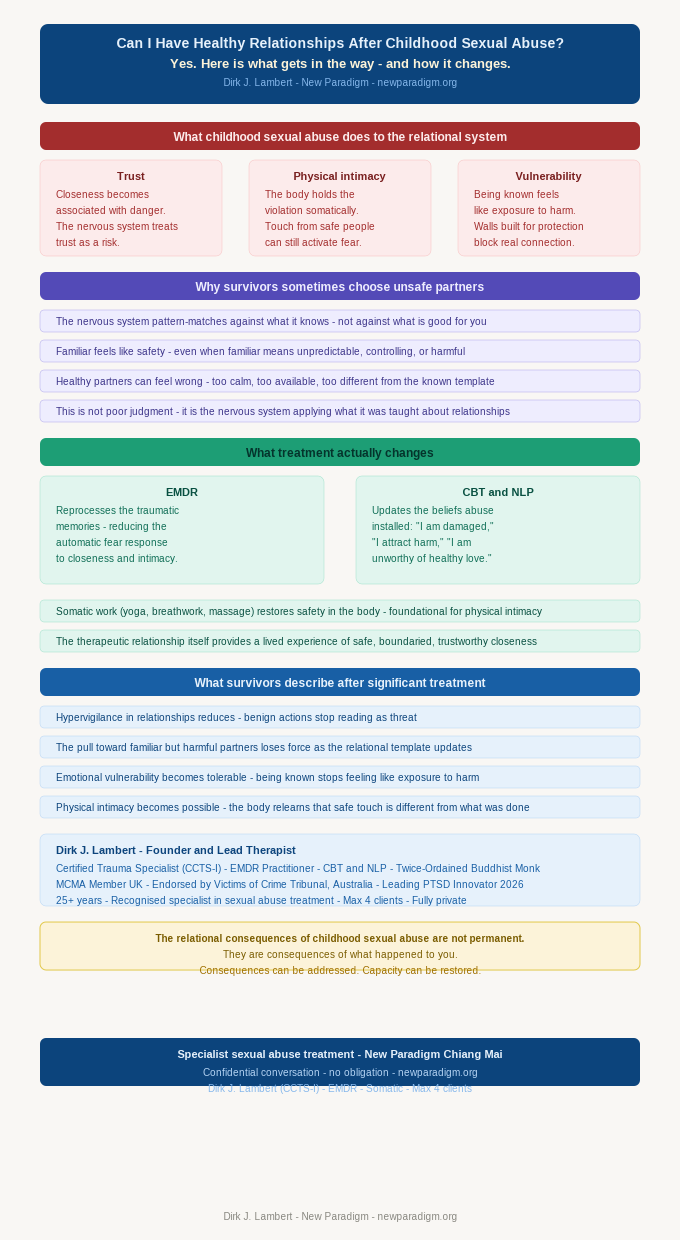
Children develop their fundamental templates for how relationships work - what to expect from others, whether closeness is safe, whether they are worthy of care - through their early relational experiences. When sexual abuse is part of that developmental environment, it installs specific and damaging templates. Closeness becomes associated with danger. Vulnerability becomes associated with violation. Trust becomes associated with betrayal. Intimacy - physical and emotional - becomes a category of experience that the nervous system treats as a threat rather than a source of safety.
These templates do not simply update when circumstances change. They persist - shaping how survivors respond to potential partners, how they read ambiguous signals in relationships, how they react to vulnerability or closeness even from people who are genuinely safe. The survivor is not choosing to distrust. They are not being difficult or damaged. Their nervous system is applying the relational rules it learned in an environment where closeness meant harm, and those rules persist until they are specifically addressed.
The relational patterns that emerge from childhood sexual abuse are varied, and survivors do not all experience the same ones. Some find themselves unable to tolerate closeness at all - withdrawing as soon as a relationship begins to feel real. Others find themselves drawn repeatedly to relationships that replicate the dynamics of the abuse - to partners who are controlling, unpredictable, or unsafe - because that relational template is what feels familiar. Some alternate between the two. None of these patterns reflect who the survivor is as a person. They reflect what the survivor's nervous system learned about what relationships are.
What Healthy Relationships Look Like for Survivors - and What Makes Them Hard
Healthy relationships require certain capacities that childhood sexual abuse can significantly compromise. Understanding specifically what those capacities are, and why the abuse affected them, removes some of the shame that survivors carry about the difficulties they experience in relationships.
Trust - the capacity to extend reasonable confidence that another person will not deliberately harm you - is directly targeted by abuse from someone known. When the person who violated you was someone you trusted, the nervous system draws the conclusion that trust itself is dangerous. This generalises to other relationships in ways that may seem disproportionate or irrational to others, but that are completely logical given what the nervous system learned. The person who flinches when their partner raises a hand in a gesture has not made a mistake. Their nervous system is correctly applying the pattern it was taught.
Physical intimacy presents particular challenges. Sexual abuse involves a violation of the body, and the body carries that violation as a somatic memory. Touch that would otherwise feel safe and connecting can trigger responses - withdrawal, dissociation, freezing, flooding - that have nothing to do with the specific person being touched and everything to do with what the body is holding from the past. Survivors often find that physical intimacy is either unavailable to them or becomes available only after significant processing work - because the body needs to relearn that touch from a safe person is different from what was done to it.
Emotional vulnerability - the willingness to be known, to let another person see difficulty and need and imperfection - is also compromised. For survivors whose abuse included elements of manipulation, of their vulnerability being exploited, of their emotional needs being weaponised against them, the idea of letting someone see them fully is terrifying. The risk of being known is equated with the risk of being used. Walls that were built as protection become, over time, a barrier to the very connection that is being sought.
The Pattern of Choosing Unsafe Partners
One of the most painful aspects of childhood sexual abuse's impact on relationships is the pull toward partners who are not safe. Many survivors find themselves repeatedly in relationships that, from the outside, seem clearly harmful - partners who are controlling, volatile, emotionally unavailable, or actively abusive. And then carry enormous shame about this, as if it reflects poor judgment or a desire to be harmed.
It reflects neither. The nervous system, when making relational choices, does not operate on conscious analysis. It pattern-matches against what it knows. When what the nervous system knows is that relationships involve a specific kind of power imbalance, a specific kind of unpredictability, a specific kind of intensity that alternates between closeness and harm - it recognises those features as familiar. Familiar, to the nervous system, is not the same as good. But it functions like safety, because it is known. Genuinely healthy relationships - with partners who are consistent, kind, and boundaried - can feel wrong precisely because they do not match the template. They feel too calm. Too safe. Too available.
This is not destiny. It is a pattern, and patterns can be understood and changed. But they cannot be changed through will alone. The nervous system that keeps pulling toward familiar but harmful dynamics is not responding to reasoning. It needs the relational template itself to be updated - through therapeutic work that specifically addresses how the abuse shaped the survivor's expectations about what relationships are.
What the Therapeutic Relationship Does
One of the most important mechanisms of recovery from childhood sexual abuse is the therapeutic relationship itself. A therapist who is consistently present, consistently boundaried, consistently non-reactive, and consistently trustworthy provides a relational experience that directly contradicts what the abuse taught. This is not a side effect of therapy. It is one of its primary mechanisms.
As the attachment theory framework makes clear, the therapeutic relationship can update the internal working models that early experience installed. A survivor whose entire relational history has confirmed that closeness leads to harm begins, in the consistent experience of a safe therapeutic relationship, to have evidence to the contrary. That evidence does not arrive as information. It arrives as lived experience - which is the only level at which the nervous system actually updates.
This is one of the reasons why the quality of the therapeutic relationship matters as much as the specific modalities used. A technically skilled therapist who is emotionally cold, who maintains distance, who does not provide genuine attunement - can process traumatic memories without providing the relational corrective experience that is also necessary for a survivor to develop the capacity for healthy relationships. Both elements are required.
EMDR, Attachment, and the Relational Template
EMDR addresses the traumatic memories that formed the relational template. When the memories of the abuse are reprocessed - when the emotional charge diminishes and the nervous system's relationship to those memories shifts from present-tense threat to past-tense event - the relational conclusions that the memories produced begin to loosen. The belief that intimacy is dangerous becomes less absolute. The automatic fear response to closeness reduces in intensity. Space opens for a different kind of relational experience to be possible.
NLP and CBT address the specific beliefs and identity-level conclusions the abuse installed - "I am damaged," "I am unlovable," "I attract harm," "closeness always ends in violation" - and work to examine and update these conclusions directly. These beliefs are not simply untrue facts to be replaced with true ones. They are deeply embedded conclusions that require careful, sustained work to shift. But they do shift. And when they do, the relational choices a survivor makes begin to change - not because they have resolved to choose differently, but because the internal landscape from which those choices are made has genuinely changed.
The body-based practices at New Paradigm address the somatic dimension of relational difficulty - restoring a sense of safety and ownership in the body that is foundational to the capacity for physical intimacy. You cannot feel safe being touched if your body is still holding the imprint of being touched unsafely. Yoga, breathwork, Thai massage, and somatic regulation practices create the conditions in which the body begins to relearn what safe physical contact is - which is necessary groundwork for intimate relationships in which touch is part of how connection is expressed.
What Changes - and What the Work Actually Looks Like
Recovery does not mean the past disappears. It means the past loses its grip on the present. Survivors who complete significant trauma processing work describe changes that are qualitative - not just a reduction in symptoms, but a different felt sense of what relationships are and what they themselves deserve.
The hypervigilance in relationships reduces. The automatic reading of benign actions as threatening settles. The pull toward familiar but harmful dynamics loses some of its force - because the nervous system is no longer operating from the same template. The capacity to tolerate vulnerability without the nervous system interpreting vulnerability as danger increases. Physical intimacy becomes something that can be present rather than avoided or endured.
None of this happens all at once, and it rarely happens linearly. Recovery has its own arc. But it happens. And in an intensive residential setting, where the density of therapeutic contact means the nervous system has sustained support and does not have to wait a week between sessions, it can happen faster and more completely than a weekly outpatient model typically allows.
Understanding why you responded the way you did during the abuse is often a necessary part of being able to move forward - because the shame about the past directly shapes the capacity for the future. You do not need to describe what happened in detail for the treatment to work - and knowing that removes one of the most significant barriers to beginning. And if emotional numbness and disconnection are part of your current experience, understanding those as symptoms of trauma rather than signs of permanent damage is part of the same recovery arc.
Healthy relationships are not a reward for the people who were fortunate enough not to be harmed. They are a human capacity - one that can be temporarily distorted by what was done to you, and one that can be restored. Contact New Paradigm for a confidential conversation about whether intensive treatment is right for your situation.
About the Author
Dirk J. Lambert is the founder and lead therapist at New Paradigm, a private mental health retreat in Chiang Mai, Thailand. He is a Certified Trauma Specialist (CCTS-I), EMDR practitioner, CBT and NLP specialist, and twice-ordained Buddhist monk with more than 25 years of clinical experience working with complex trauma, PTSD, depression, and attachment disorders. Dirk founded Thailand's first alternative recovery centre in 2000 and established New Paradigm in 2014. He is a recognised specialist in the treatment of sexual abuse survivors, an endorsed provider through the Victims of Crime Assistance Tribunal in Melbourne, Australia, a member of the Complementary Medical Association UK (MCMA), and was named Leading PTSD Innovator in 2026 by Global Health and Pharma. He works personally with every client who enters the programme.