The appointment was routine. A smear test, a pelvic exam, a breast check, a rectal exam, an internal scan. It took ten minutes and, on paper, nothing went wrong. Yet you sat in the car afterwards and shook. Maybe you cried and could not say why. Maybe you felt dirty, angry or strangely numb, and the feeling has not left.
If that is you, you are not overreacting. Many people carry this in silence, because the person who touched them was "only doing their job". Here is why it happens, how to tell clumsy care from a breach of consent and from abuse, the signs that it has turned into trauma, how to make the next appointment safer, and what treatment can do.
Why Do I Feel Violated After a Medical Exam?
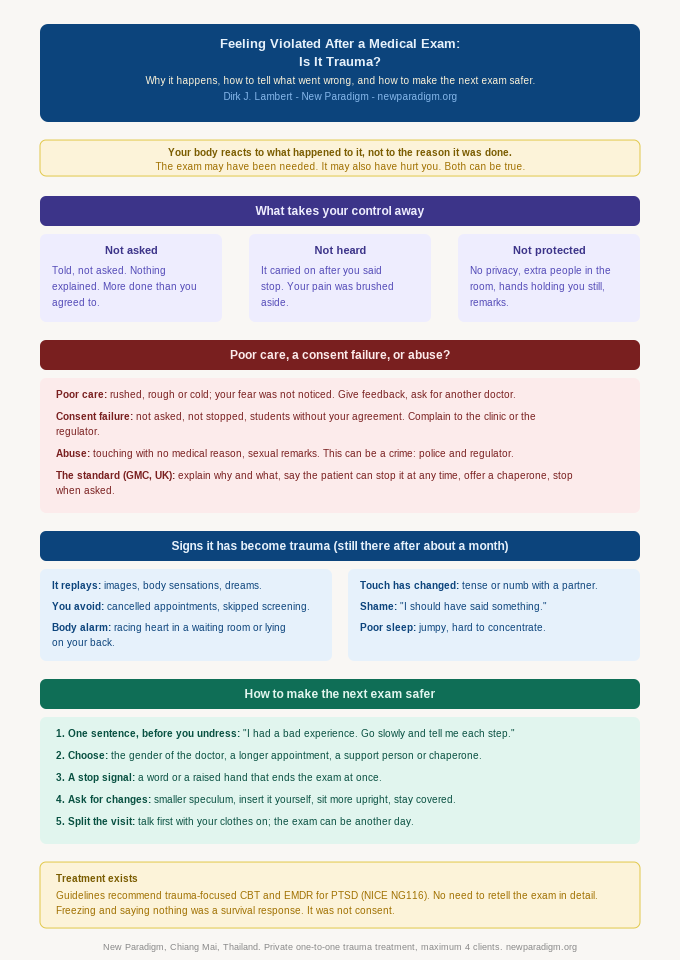
You feel violated because your body went through something it reads as a violation. You were undressed, touched or entered in an intimate place, with little say in it, by someone who held more power than you. Your nervous system reacts to what happened to the body, not to the reason it was done. A medical purpose does not cancel that reaction.
Two things can be true at once: the exam may have been needed, and it may also have hurt you. When the feeling stays for weeks, or you start to avoid doctors, it can be a trauma response. It responds to the same one-to-one treatment for trauma and PTSD that helps after an accident or an assault.
This is not only about gynaecology, and not only about women. Men describe the same feeling after prostate, rectal and genital exams, and tell even fewer people. Children who were held still for a procedure can carry it into adult life.
What Makes an Exam Feel Like a Violation
It is rarely one big event. More often it is a handful of small things that together took your control away:
- Nobody asked. You were told what would happen, not asked. Or nothing was explained at all.
- It carried on. You said stop, flinched, cried or went rigid, and the exam went on.
- Your pain was brushed aside. "Just relax." "It is only a bit of pressure." "Nearly done."
- You were exposed. No privacy to undress, no sheet, a door that opened, your body left uncovered longer than needed.
- Extra people were in the room. Students or observers you never agreed to.
- You were held. Hands on your knees, your arms or your shoulders to keep you still.
- Something was done that you did not agree to, or you learned later that an exam took place while you were sedated.
- Remarks were made about your body, your weight, your sex life or your history.
- It was rushed. No time to ask a question, no time to get ready, no word afterwards.
None of this needs bad intent to do harm, and a kind but hurried doctor can leave a patient shaking. Intent matters for a complaint. For your nervous system, what counts is that you felt you had no way out.
Maternity care is a common setting. In a survey of 2,138 women in the United States, one in six reported mistreatment during pregnancy or birth care, such as loss of autonomy, being shouted at or scolded, or having requests for help ignored (Vedam et al., Reproductive Health, 2019).
Poor Care, a Consent Failure, or Abuse?
These are three different things, and each can leave the same feeling behind.
| What it is | What it looks like | What you can do |
|---|---|---|
| Poor care | Rushed, rough or cold. Little explanation. Your pain or fear was not noticed. | Give feedback or complain. Ask for a different doctor next time. |
| A consent failure | You were not asked. The exam went on after you said stop. Students took part without your agreement. More was done than you agreed to. | Make a formal complaint to the clinic or hospital, and to the regulator if you wish. |
| Abuse | Touching with no medical reason. Sexual remarks. Being asked to undress more than the exam needs, with no explanation. | This can be a crime. You can report it to the police and to the regulator. |
The standard is clearer than many patients know. In the United Kingdom, the General Medical Council tells doctors what to do before an intimate examination: explain why it is needed and what it involves, including any pain, tell the patient they can ask for it to stop at any time, offer a chaperone, and give privacy to undress. During the exam the doctor should stop if the patient asks, and keep comments professional (GMC, Intimate examinations and chaperones).
In the United States, federal guidance issued in April 2024 reinforced the duty of hospitals to obtain informed consent before breast, pelvic, prostate and rectal examinations done for teaching, in particular on patients under anaesthesia (CMS memo QSO-24-10-Hospitals). That guidance was needed because such exams had been taking place without the patient knowing.
If a health professional touched you sexually, that is sexual abuse, whatever the setting and whatever title the person holds. Our page on confidential treatment after sexual abuse describes how that work is done.
You do not have to settle which of the three it was before you look for help. Trauma is measured by what the event did to you, not by a ruling on the doctor. This article is not legal advice. A patient advocate or a lawyer can tell you where you stand.
Why Your Body Reacts So Strongly
The position. You are lying down, partly undressed and often unable to see what is being done, while someone stands over you. Few situations in adult life leave a body more exposed.
The power gap. The doctor has the knowledge, the room and the authority, and most of us were raised to do as the doctor says. Saying "stop" to a professional in the middle of an exam takes more than most people can find in that moment.
The freeze. When a body cannot fight or leave, it goes still and quiet. Many people lie there, say nothing, even say "thank you" on the way out, and later ask themselves why they did not speak. Freezing is automatic, and it is not agreement. We explain how it works in Why Didn't I Stop It? Freeze Response in Child Abuse. The same reflex is at work in adults.
The body keeps the record. The mind files the visit under "health check". The body files pressure, pain, cold metal and helplessness. That is why a smell of disinfectant or a hand on your knee can bring it all back with no picture attached. See Somatic Flashbacks: When the Body Remembers Without Images.
If You Have Been Abused or Assaulted Before
For survivors of sexual abuse or assault, an intimate exam can repeat the outline of what happened: the position, the loss of control, the touch you did not choose. Your body may respond to then and now at the same time.
Research backs this up. In a study of 67 women veterans, distress during a pelvic exam was highest in women who had a history of sexual violence and PTSD, lower in women with a history of sexual violence alone, and lowest in women with neither (Weitlauf et al., Obstetrics and Gynecology, 2008). A 2024 review of 23 studies came to the same conclusion: most of the studies on the question linked past violence with more discomfort, anxiety, distress and pain during pelvic exams (Iraola et al., Trauma, Violence and Abuse, 2024).
That does not make your reaction "really about the past". If the exam was careless, it was careless. It does explain why a doctor who saw nothing unusual may have left you in pieces. For the exam that follows an assault, see Medical Examination After Sexual Assault: Why It Can Hurt.
Signs It Has Become Trauma
Being shaken for a few days is a normal response to a bad experience, and it usually settles. It is worth getting help when the signs below are still there after about a month, or when they get in the way of your life:
- It replays. The exam comes back in images, in body sensations or in dreams.
- You avoid. You cancel appointments, skip screening, put off a follow-up, or take another road so you do not pass the clinic.
- Your body sounds the alarm. Your heart races or you feel sick in a waiting room, at the smell of disinfectant, or when you lie on your back.
- Touch has changed. Sex, a massage or a hug from your partner now makes you tense or numb.
- Shame and self-blame. "I should have said something." "It was only an exam."
- Anger or tears that seem too big for what you tell yourself happened.
- Poor sleep, jumpiness, trouble concentrating.
Avoidance is the sign that costs most, because a missed smear test or an unchecked lump is a health risk of its own. That alone is reason enough to take this seriously.
Only a qualified professional can make a diagnosis. Surgery, intensive care and emergency treatment can leave similar marks. We cover those in Trauma from Medical Procedures: Symptoms and EMDR Treatment.
What Helps in the First Days and Weeks
- Take your own reaction seriously. You do not need anyone's permission to be upset.
- Write it down. Date, place, who was in the room, what was said and done. Memory fades. Notes keep your options open, whether or not you ever use them.
- Tell one safe person. Shame grows in silence. One person who listens without "but they are a doctor" is enough.
- Look after the basics. Sleep, regular meals, a walk, a slow breath with a longer out-breath.
- Know your options. You can ask for your records. You can give feedback or complain to the clinic, the hospital's patient service or the regulator. Some routes have time limits, so check them early. Complaining is your choice, not a duty.
- Do not let urgent care slide. If a follow-up cannot wait, go with someone you trust and use the steps below.
How to Make the Next Exam Safer
You are allowed to set terms, and a good doctor will welcome them. The American College of Obstetricians and Gynecologists asks its members to use a trauma-informed approach at every level of their practice (ACOG Committee Opinion 825). In plain terms: the patient is told, asked and kept in control.
- Say it in one sentence, before you undress. "I had a bad experience with an exam. Please go slowly and tell me each step before you do it." You owe no details.
- Choose who and when. Ask for a doctor or nurse of the gender you prefer, and for a longer appointment.
- Bring someone. A friend or partner in the room, a chaperone, or both.
- Agree a stop signal. A word or a raised hand. Agree that the exam stops at once, not "in a second".
- Ask for changes. A smaller speculum. Inserting it yourself. Sitting more upright. A sheet over your lap. Seeing the instruments first.
- Split the visit. Talk first with your clothes on. Have the exam another day if you need to.
- Ask about other ways. For cervical screening, ask whether a sample you take yourself is offered where you live.
- Leave if you are not respected. You can stop an exam and walk out. That is your right, not rudeness.
How Trauma Treatment Helps
Trauma from a medical exam is treatable. Guidelines recommend trauma-focused therapies for adults with PTSD: trauma-focused cognitive behavioural therapy and EMDR (NICE guideline NG116). The World Health Organization names the same two approaches (WHO, 2013).
EMDR works with the memory itself. While you hold a part of it in mind, you follow a moving light or listen to alternating tones for short sets. The memory is still there afterwards, but the aim is that it loses its charge: it becomes something that happened, not something that is still happening.
You do not have to describe the exam in detail. Many people fear that therapy means saying it all out loud to one more professional. It does not: see Will I Have to Talk About My Trauma in Detail? No.
Body-based work sits alongside it. Slow breathing, grounding and learning to notice tension early help you stay steady when you are touched or lying down. Treatment cannot undo what happened. The aim is that the memory stops running your body, and that you can get the health care you need.
Treatment at New Paradigm
At New Paradigm, every therapy session is one-to-one with Dirk J. Lambert. There is no group therapy, and you share only what you choose to share. EMDR is the core method, combined with CBT and somatic work as needed. Every session starts with regulation and ends with containment, and the pace is decided in the room.
A single bad exam, with no older trauma under it, is single-incident trauma. That can often be worked through in a short, focused course of a few sessions. Outpatient sessions in Chiang Mai or online are usually the right place to start. When the exam has reopened older abuse, the work is slower and has more layers. For that, the 14-day residential programme, with at most four clients on site, gives more room. No outcome is promised.
The free emotional evaluation takes about 5 to 8 minutes, and Dirk reviews it personally within 24 hours. You can also contact New Paradigm and speak with Dirk about what happened and what would help.
New Paradigm is not an emergency service. If you are in immediate danger or thinking about ending your life, call your local emergency number or find a crisis line in your country at findahelpline.com.
Related reading
- Trauma from Medical Procedures: Symptoms and EMDR Treatment
- Medical Examination After Sexual Assault: Why It Can Hurt
- Somatic Flashbacks: When the Body Remembers Without Images
About the Author
Dirk J. Lambert is the founder and lead therapist at New Paradigm, a private mental health retreat in Chiang Mai, Thailand. He is a Certified Trauma Specialist (CCTS-I), EMDR practitioner, CBT and NLP specialist, and twice-ordained Buddhist monk with more than 25 years of clinical experience working with complex trauma, PTSD, depression, and attachment disorders. Dirk founded Thailand's first alternative recovery centre in 2000 and established New Paradigm in 2014. He is a recognised specialist in the treatment of sexual abuse survivors, an endorsed provider through the Victims of Crime Assistance Tribunal in Melbourne, Australia, a member of the Complementary Medical Association UK (MCMA), and was named Leading PTSD Innovator in 2026 by Global Health and Pharma. He works personally with every client who enters the programme.