It is the most human question anyone considering this kind of programme asks - and it deserves a direct, honest answer rather than a vague promise of transformation. The timeline of recovery in intensive residential treatment is real, specific, and sometimes different from what people expect. Understanding what tends to happen and when is one of the most useful things you can know before you arrive.
This article covers what the 14-day intensive programme at New Paradigm looks like in terms of hours, modalities and daily structure, what the week-by-week arc of the programme typically feels like, when people first notice significant shifts, what the post-programme integration period looks like, and what makes change last beyond the residential stay.
What 50 Hours of Treatment Per Week Actually Means
The standard outpatient therapy model provides one hour of therapeutic contact per week. For someone carrying significant trauma, this means one hour of engagement with the material followed by six days and twenty-three hours in which ordinary life - with all its demands, triggers, and patterns - reasserts itself. Progress happens, but slowly, and the nervous system re-regulates between sessions in ways that mean the next session often begins a considerable distance from where the last one ended.
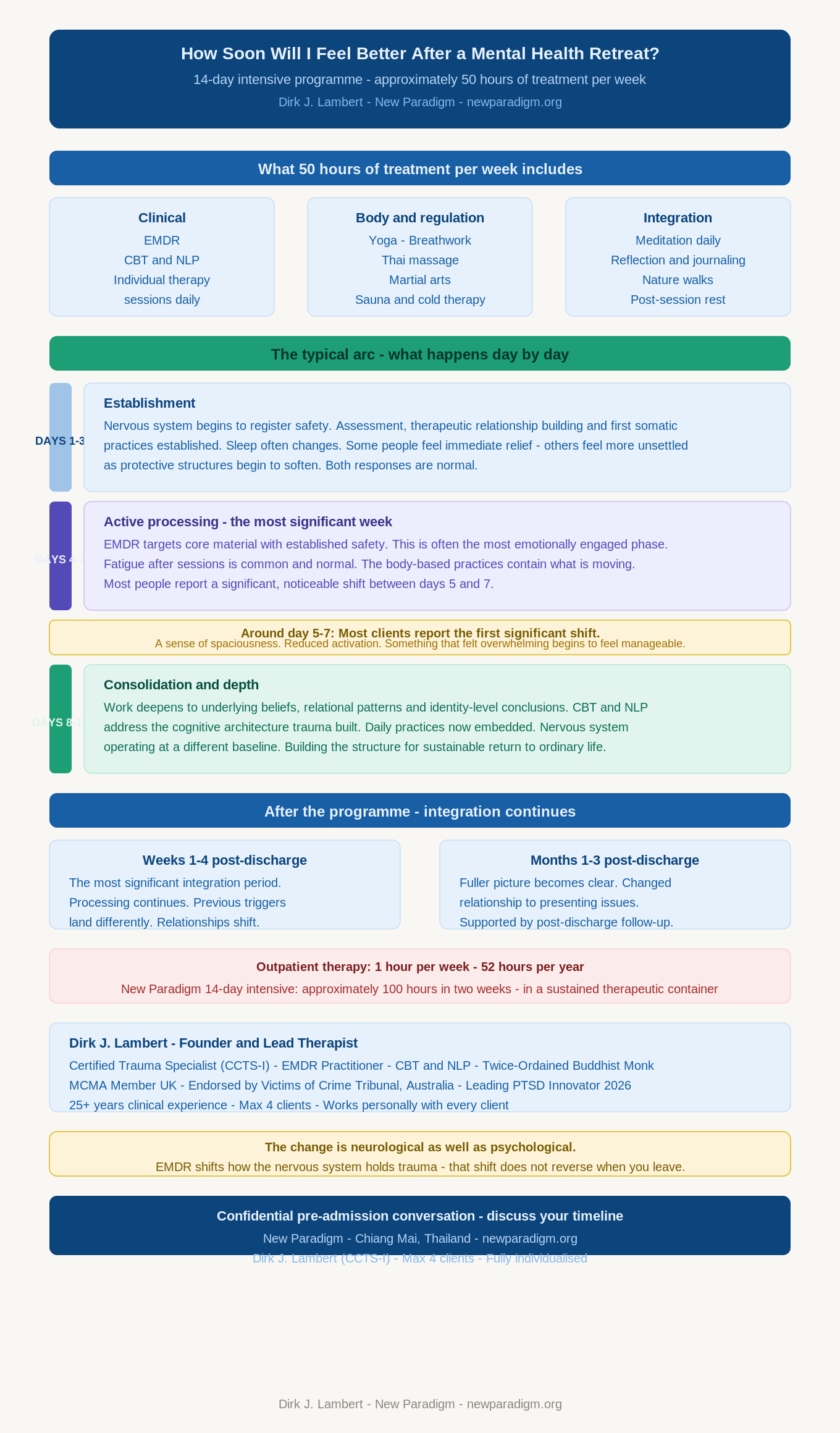
The 14-day intensive programme at New Paradigm provides approximately fifty hours of structured therapeutic contact per week. This is not the same as simply doing more of the same thing more quickly. The intensive format creates a qualitatively different therapeutic environment in which the nervous system does not have the opportunity to return to its habitual defensive posture between interventions. Processing builds on itself across consecutive days rather than starting from scratch each week.
Those fifty hours across a seven-day week are distributed across a structured daily programme that integrates clinical therapeutic work with body-based regulation practices. A typical day includes morning yoga and breathwork to regulate and prepare the nervous system for the day's work; EMDR sessions targeting specific traumatic material; CBT and NLP sessions addressing cognitive patterns, beliefs, and behavioural responses; Thai massage and somatic bodywork to access and release trauma held in the body; guided meditation and mindfulness practice; martial arts training for embodiment, physical confidence, and present-moment engagement; and sauna and contrast therapy - including cold immersion - which has a direct and evidence-supported effect on autonomic nervous system regulation and stress resilience. Understanding the full structure of a day at New Paradigm gives a concrete picture of how this is organised from morning through to evening.
The Typical Arc - What Happens Day by Day
The experience of the programme does not follow a steady upward line from distress to relief. It has a shape, and knowing that shape in advance makes it considerably easier to move through.
Days one to three are primarily about establishment. The nervous system, arriving from the demands and stressors of ordinary life, needs time to register that it is in a different and safer environment. This does not always feel good immediately. Some people experience a significant sense of relief and relaxation in the first day or two. Others feel initially more anxious or unsettled as the structure that was keeping them functional begins to soften. The first sessions establish the therapeutic relationship with Dirk, complete the clinical assessment, identify the primary targets for EMDR processing, and begin the somatic and mindfulness practices that will support the deeper work. Sleep in the first two to three days often changes - sometimes deeper, sometimes more restless, frequently accompanied by more vivid dreams as the nervous system begins to process.
Days four to seven are typically where the most significant processing happens. EMDR sessions are now targeting core material with an established therapeutic relationship and a nervous system that has begun to settle into the programme's rhythm. This is where many people have their most difficult days - not because something is going wrong, but because something is going right. When the material that has been frozen or defended is beginning to move, there is often an emotional quality to the days that is unfamiliar and sometimes intense. Fatigue after sessions is common and normal. The hours of yoga, massage, meditation, and martial arts practice that surround the clinical sessions are not incidental - they are the container that makes this level of processing safe.
By day seven, most people report a noticeable and significant shift. Not the end of the work, but a genuine change in the relationship to the material that was bringing them to the programme. Something that felt overwhelming has become more manageable. A memory that was activating the nervous system has lost some of its charge. A pattern that felt completely automatic has begun to feel less inevitable. This shift is often quiet rather than dramatic - a sense of spaciousness where there was previously constriction, a quality of calm that has not been accessible for some time.
Days eight to fourteen consolidate and deepen what the first week has opened. With the primary traumatic material having begun to shift, the work in the second week often moves to the layers that sit beneath the presenting issues - the beliefs, the relational patterns, the identity-level conclusions that the traumatic experience installed. CBT and NLP are particularly active in this phase, working with the cognitive architecture that trauma built. The daily practices - now embedded as a rhythm - are producing their own cumulative effects. The nervous system is functioning at a different baseline. People who arrive unable to sit in meditation for five minutes are typically completing twenty to thirty-minute sessions by the end of the second week.
Why the First Days Sometimes Feel Harder Before They Feel Better
This is the part that surprises people who arrive expecting immediate relief, and it is worth naming directly. Trauma creates a particular kind of adaptation: the nervous system builds structures around the unbearable in order to keep functioning. These structures - numbness, hypervigilance, dissociation, over-control, chronic busyness - are costly, but they work. When you remove yourself from the ordinary environment that requires those structures and place yourself in a therapeutic environment that is explicitly designed to make them unnecessary, the structures begin to soften. That softening can feel, initially, like things are getting worse.
It is also true that effective trauma processing - particularly EMDR - involves, briefly, making contact with material that has been avoided. The technical term is "activating the trauma network." This is not retraumatisation - the process includes specific resourcing, titrated exposure, and bilateral stimulation that allows the material to be processed rather than simply re-experienced. But it can produce a quality of emotional engagement in the hours after sessions that is unfamiliar and sometimes uncomfortable. This is normal, it is time-limited, and the yoga, massage, breathwork, and cold therapy built into the afternoon and evening are specifically designed to support the nervous system through it.
When People First Notice Significant Change
Across the population of people who attend New Paradigm, the most common point at which a significant and noticeable shift is first reported is between days five and eight. This is not a rule - some people notice meaningful change within the first two or three days, particularly in terms of physical symptoms of stress and tension. Others carry more complex or layered material and the first significant shift comes closer to the end of the first week or the beginning of the second.
What the shift tends to feel like varies by presentation. For someone carrying PTSD, it often manifests first as a change in how a specific memory feels - it loses the quality of being happening now and begins to feel like something that happened then. For someone with anxiety, it is often first noticed as a reduced level of background activation - a quietness in the body that has not been present for years. For someone in burnout, it frequently first appears as the capacity to rest - to actually switch off rather than simply lying still with a racing mind.
The Weeks After - When Integration Continues
The end of the 14-day programme is not the end of the process. In intensive trauma treatment, the residential period initiates changes that continue to develop and integrate for weeks and months after the person returns home. The nervous system continues to settle. The processing that began in sessions continues, often producing new understanding, new emotional releases, and new capacities in the weeks following the programme.
The first two to four weeks after returning home are typically the most significant integration period. People often notice during this time that situations which previously triggered strong automatic responses are landing differently. Relationships begin to shift in response to the person's changed internal state. The coping strategies and regulation practices embedded during the programme - the meditation, the breathwork, the physical practices - provide a foundation that supports the continued integration.
At New Paradigm, post-discharge follow-up is built into the programme structure. The transition back to ordinary life, and the support of ongoing outpatient therapy where appropriate, is planned before the residential stay ends. Dirk provides referrals to qualified practitioners in the client's home country where continuing therapeutic work is indicated, ensuring that what was opened in the residential programme has appropriate support as it continues to settle.
What Makes the Change Last
The change produced by intensive trauma-focused residential treatment is neurological as well as psychological. EMDR changes the way traumatic memories are stored - they move from an unprocessed, activating state to an integrated, contextualised state. This change does not simply dissipate when the programme ends. The nervous system that has been shifted does not automatically return to its previous baseline. The work that has been done is real.
What determines whether the change lasts is primarily what happens in the months after the programme - whether the daily practices are maintained, whether appropriate ongoing therapeutic support is in place, whether the person makes use of the new internal resources the programme has built. The people who sustain the most significant long-term change are those who treat the residential programme as a beginning rather than an end - a point from which a different quality of life becomes possible, rather than a cure that requires nothing further from them. The evidence for whether this level of treatment produces lasting results addresses this directly and is worth reading alongside this article.
The question of which conditions respond best to this approach - and what specifically the intensive format achieves that weekly outpatient therapy does not - is covered in detail in what mental health issues retreats treat best. And if you are at the stage of assessing whether this is the right level of care for your specific situation, the clinician's guide to choosing a trauma retreat provides the framework for making that assessment clearly.
Contact New Paradigm today for a confidential pre-admission conversation about your specific situation, your timeline, and what a 14-day intensive programme is likely to produce for you.
About the Author
Dirk J. Lambert is the founder and lead therapist at New Paradigm, a private mental health retreat in Chiang Mai, Thailand. He is a Certified Trauma Specialist (CCTS-I), EMDR practitioner, CBT and NLP specialist, and twice-ordained Buddhist monk with more than 25 years of clinical experience working with complex trauma, PTSD, depression, and attachment disorders. Dirk founded Thailand's first alternative recovery centre in 2000 and established New Paradigm in 2014. He is a recognised specialist in the treatment of sexual abuse survivors, an endorsed provider through the Victims of Crime Assistance Tribunal in Melbourne, Australia, a member of the Complementary Medical Association UK (MCMA), and was named Leading PTSD Innovator in 2026 by Global Health and Pharma. He works personally with every client who enters the programme.
Frequently Asked Questions
Is it normal to feel worse before I feel better in the first few days?
Yes - and it is one of the most important things to understand before you arrive. The structures the nervous system has built around trauma - numbness, hypervigilance, chronic busyness, emotional suppression - exist because they work. When you remove yourself from the environment that requires them and place yourself in a therapeutic setting designed to make them unnecessary, those structures begin to soften. That process can initially feel like things are getting worse, because the protection is reducing before the underlying material has fully shifted. This is a normal and expected part of intensive trauma work. It is time-limited, and the full daily programme - the yoga, massage, meditation, breathwork, and cold therapy - is specifically designed to support the nervous system through this phase. Clients who are prepared for the possibility of some initial discomfort navigate it considerably more easily than those who expect immediate relief.
How does 50 hours of treatment per week compare to what I can get at home?
Standard outpatient therapy provides one hour per week of therapeutic contact. Intensive outpatient programmes may offer ten to fifteen hours per week, typically in group formats. The 14-day New Paradigm programme provides approximately fifty hours per week of individual, one-on-one therapeutic engagement across EMDR, CBT, NLP, somatic bodywork, and integrative practices. This is not simply a quantitative difference - it is a qualitative one. The concentrated format prevents the nervous system from returning to its habitual defensive posture between sessions, allows processing to build across consecutive days, and creates conditions in which change that might take years of weekly therapy can happen in weeks. For complex trauma in particular, the intensive residential format is clinically in a different category from anything weekly outpatient therapy can produce.
What does a significant shift actually feel like? How will I know it has happened?
People describe the first significant shifts in a range of ways, and they tend to be specific to the presenting issue rather than generic. Someone carrying PTSD often first notices that a specific memory has changed quality - it no longer carries the felt sense of happening now, and can be thought about without the body activating. Someone with anxiety often first notices a period of genuine quiet in the body - an absence of background tension that has been constant for so long it was no longer registered as unusual. Someone in burnout typically first notices the capacity to actually rest - not just to lie still, but to actually switch off. The shifts are often quieter than people anticipate - less dramatic revelation, more a sense of spaciousness or settledness that simply was not there before. By the end of the 14 days, most people can identify multiple specific things that have changed, in ways they can describe concretely.
Will the results last after I leave the programme?
The changes produced by intensive EMDR and trauma-focused residential treatment are neurological as well as psychological. EMDR specifically changes the way traumatic memories are stored in the nervous system - moving them from an unprocessed, constantly activating state to an integrated, contextualised one. This change does not simply reverse when the programme ends. The nervous system that has been shifted does not automatically return to its previous baseline. That said, what determines the longevity and depth of the results is significantly influenced by what happens in the weeks and months following the programme - whether daily regulation practices are maintained, whether appropriate ongoing therapeutic support is in place, and whether the person engages with their life from the new internal ground the programme has created. Post-discharge follow-up and referrals to ongoing support are built into the New Paradigm programme structure specifically to support this transition.
What if I do not feel significantly better by the end of 14 days?
This is rare, but it is an honest question and deserves an honest answer. The 14-day programme produces significant, noticeable change for the large majority of people who attend, particularly when the pre-admission assessment has established that intensive residential treatment is the appropriate level of care for the presenting situation. Occasionally, someone carries material that requires more time or a different sequencing than the standard programme structure provides, and this becomes clear during the programme rather than before it. In these situations, the programme is adapted in real time - extending where this is possible and appropriate, adjusting the modalities, or identifying the most important work to consolidate within the remaining time and establishing a clear plan for continuation. The pre-admission assessment is designed to minimise the likelihood of a mismatch between the programme and the person's needs - and the honest conversation that happens there is one of the most important parts of the entire process.