She was 21, two months into her first posting, and good at her job. The comments started in the first week. Then the hand on her back in the corridor, the messages at night, the sergeant who made sure she was always on his shift. When she finally raised it, she was asked whether she was sure, whether she wanted to ruin a good man's career, whether she could not just handle it like everyone else did. She handled it. She finished her contract, left with a good report, and never told anyone again. Twenty years later she still sits with her back to the wall, still cannot stand a particular aftershave, and still wakes at 3 a.m. with her heart pounding for no reason she can name.
Her story is not unusual, and it is not only a woman's story. Sexual harassment and sexual assault in the armed forces have a name: military sexual trauma, or MST. This article explains what military sexual trauma is, why it so often causes deeper and longer-lasting harm than people expect, what its consequences look like years after service, and how it is treated, including what treatment looks like at New Paradigm.
What Is Military Sexual Trauma?
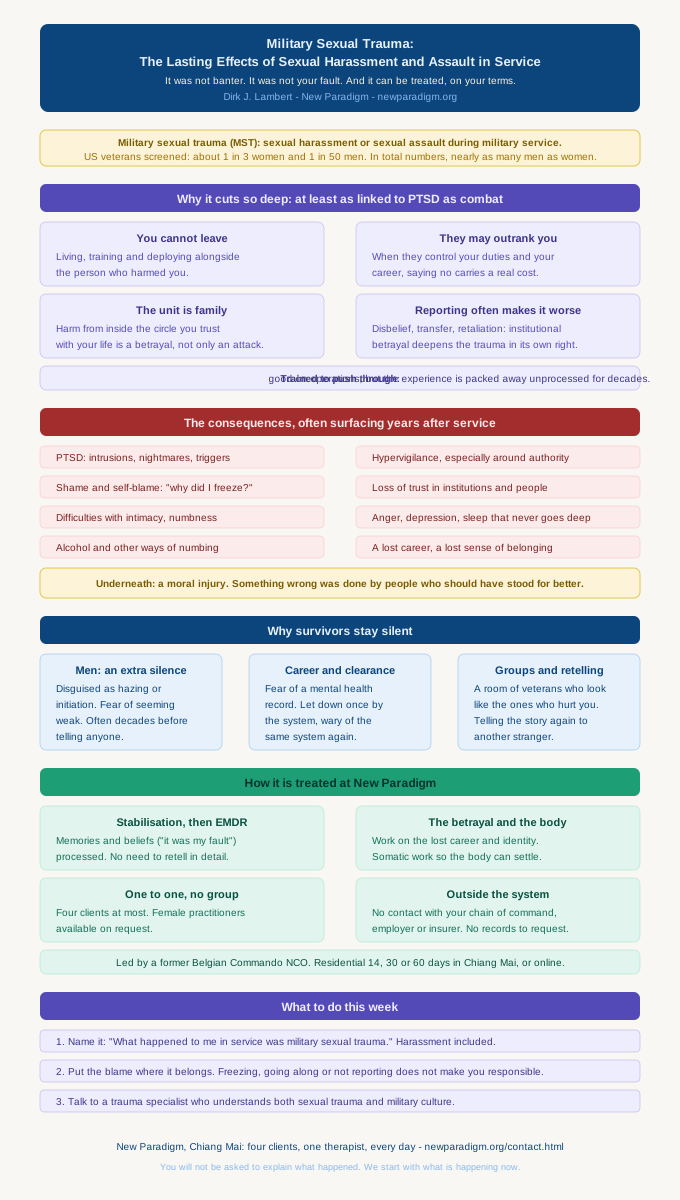
Military sexual trauma is sexual harassment or sexual assault experienced during military service. The term comes from the United States Department of Veterans Affairs, and it is deliberately broad. It includes rape and sexual assault, but also unwanted sexual touching, threats or pressure linked to rank or career, and repeated, unwanted sexual comments or advances. Harassment counts. Many survivors never use the word "trauma" for what happened to them because "it was only harassment". The research does not support that distinction. Sustained sexual harassment in a setting you cannot leave can leave the same marks as a single assault.
It is also common. When veterans are screened by the US Veterans Affairs system, about one in three women and about one in fifty men say they experienced military sexual trauma, according to the VA fact sheet on military sexual trauma. Because far more men than women serve, the number of men affected is close to the number of women. In the United Kingdom, a 2021 parliamentary inquiry heard from servicewomen and female veterans that almost two thirds had experienced bullying, harassment or discrimination during service. Australia's Royal Commission into Defence and Veteran Suicide heard extensive evidence of sexual violence and harassment within the Defence Force. This is not a problem of one country or one service.
At New Paradigm I offer private trauma treatment for serving personnel and veterans, and military sexual trauma is part of that work. I served as a non-commissioned officer in a Belgian Commando unit before I trained as a psychotherapist. I know the culture this kind of harm happens in, and I know why it is so hard to talk about from inside it.
Why Military Sexual Trauma Cuts So Deep
Research among veterans has found that military sexual trauma is at least as strongly linked to PTSD as combat exposure, and in some studies more so. People are often surprised by that. The reasons lie in the specific conditions of military life.
- You cannot leave. In civilian life you can quit a job or move out. In service, you may have to keep living, eating, training and deploying alongside the person who harmed you, sometimes for years. The threat is not a memory. It is in the next room.
- The perpetrator may outrank you. When the person harassing you controls your duties, your evaluations and your career, saying no carries a real cost. Many survivors describe going along with things they did not want because the alternative seemed worse.
- The unit is supposed to be family. Military life is built on trust: you rely on the people around you with your life. When the harm comes from inside that circle, it is not just an assault. It is a betrayal of the one thing that is supposed to be unbreakable.
- Reporting often makes it worse. Survivors who report are frequently disbelieved, moved instead of the perpetrator, labelled as troublemakers, or quietly pushed out. Psychologists call this institutional betrayal: harm made worse by the institution that should have protected you. Studies show it intensifies trauma symptoms in its own right. I have written separately about how seeking help can cause more pain, and in the military that risk is higher still.
- You were trained to push through. Military training teaches you to suppress fear, carry on and not let the team down. Those are good skills on operations. Applied to sexual trauma, they mean the experience is packed away, unprocessed, and carried for decades.
The Consequences: How Military Sexual Trauma Shows Up
The effects of military sexual trauma often appear while the person is still serving, but just as often they surface years later, after discharge, when the structure and busyness of military life fall away. A delayed trauma response is common in this group. These are the consequences I see most often:
- PTSD symptoms. Intrusive memories, nightmares, sudden waves of fear triggered by a smell, a uniform, a tone of voice or a type of building.
- Hypervigilance. Back to the wall, scanning every room, unable to relax around certain kinds of men or women, or around anyone in authority.
- Shame and self-blame. "I should have fought back." "I should have reported it sooner." "Why did I freeze?" These questions can occupy a survivor for years. Freezing is a reflex, not a choice, and I have written about the shame that keeps survivors silent in more detail.
- Loss of trust. In institutions, in authority, in colleagues, sometimes in everyone. Many survivors stop trusting their own judgement about who is safe.
- Difficulties with intimacy and relationships. Avoiding sex, feeling numb or absent during it, or finding that closeness triggers fear. Numbness and detachment from loved ones are very common.
- Anger, depression and sleep problems. Irritability that seems out of proportion, low mood that does not lift, sleep that never goes deep.
- Alcohol and other ways of numbing. Often started during service, where drinking culture made it easy to hide.
- A lost career and a lost identity. Many survivors leave the military earlier than they planned, or are pushed out. They lose not only a job but a sense of belonging and purpose, and often their pride in having served.
Underneath many of these sits something close to what we see in combat veterans as moral injury: the sense that something fundamentally wrong was done, by people and an institution that were supposed to stand for something better. That layer needs its own attention in treatment. It does not dissolve just because the fear responses settle.
Men and Military Sexual Trauma
Men who experience military sexual trauma face an additional layer of silence. The assault may have taken place as part of hazing or an initiation ritual, presented as a joke or a test of toughness. Many men do not recognise what happened to them as sexual assault at all, or fear that naming it will make them seem weak, or will raise questions about their sexuality. As a result, men are even less likely than women to report, and often wait decades before telling anyone. When they do seek help, it is usually for something else: anger, alcohol, a marriage in trouble, depression. The trauma underneath is only discovered later, if at all. If you are a man reading this and recognising yourself, you are not alone, and what happened to you was not a test you failed.
Why Survivors Often Do Not Seek Help
Even when the effects are severe, many survivors put off treatment for years. The reasons are understandable. Some are still serving and fear what a mental health record would do to their career or their security clearance. Some have already been let down by the system once and are reluctant to turn to another part of the same system. Some have been offered group therapy with other veterans and cannot imagine describing sexual trauma in a room full of people who look and talk like the ones who hurt them. And many dread having to tell the story again, in detail, to yet another stranger.
Each of these concerns deserves a real answer, not reassurance. The structure of treatment matters as much as the method.
How Military Sexual Trauma Is Treated at New Paradigm
Military sexual trauma responds well to treatment, including when it is decades old. The approach I use combines trauma-focused therapy with a setting designed around the concerns above.
Stabilisation first. Before any memory is processed, we build the capacity to stay present and grounded: body-based regulation, sleep, and a working relationship of trust. Nothing is forced, and you stay in control of the pace throughout.
EMDR for the memories. EMDR is endorsed by the World Health Organization as a first-line treatment for PTSD. It works directly on the stored memories: the image, the sensation in the body, and the belief attached to it, such as "it was my fault" or "I am not safe". As each memory is processed, it stops acting as a live threat and becomes something that happened, in the past. You do not have to talk about your trauma in detail for this to work, which matters a great deal for survivors who have already told their story too many times, or never want to tell it at all.
Work on the betrayal and the beliefs. Alongside EMDR, we work with the beliefs the experience installed and with the institutional betrayal: the anger, the grief for a career and an identity, the loss of faith in something you once believed in. This is the part that is often left out, and without it treatment feels incomplete.
The body. Sexual trauma is held in the body as much as in memory. Somatic work, breathwork, trauma-informed yoga and gentle physical training help the nervous system come down to a baseline it can hold, and help survivors feel at home in their own bodies again.
The setting is built for this work. Every session is one to one. There is no group therapy and no shared disclosure. There are never more than four clients on site, in a private property in the hills outside Chiang Mai. Female practitioners are available for clients who prefer to work with a woman. And New Paradigm is a private retreat, not a military or government facility: we do not communicate with your chain of command, your employer, your insurer or any government body, and we hold no records that a third party can request. For serving personnel, that discretion is often what makes treatment possible at all.
Residential programmes run for 14, 30 or 60 days, with daily EMDR. For those who cannot travel yet, I also work with clients online. You can read more about our approach to sexual abuse and assault recovery, which applies here as well. New Paradigm is an endorsed provider through the Victims of Crime Assistance Tribunal in Melbourne, Australia, and I have worked with veterans since the 1990s, when I accompanied American and Australian Vietnam veterans back to Vietnam. Military sexual trauma sits where those two areas of my work meet.
What to Do This Week
If you recognise yourself in this article, three steps are worth taking now:
- Name it. Say it to yourself in plain words: "What happened to me in service was military sexual trauma." Harassment included. Not "banter", not "just how it was".
- Put the blame where it belongs. Freezing, going along, not reporting, reporting and not being believed: none of it makes you responsible for what someone else chose to do.
- Talk to a trauma specialist who understands both worlds. Someone who knows sexual trauma and knows military culture, and who can offer you treatment on your terms.
If you are ready for that conversation, contact New Paradigm in confidence. You will not be asked to explain what happened. We will start with what is happening now, and decide together what the right next step is.
About the Author
Dirk J. Lambert is the founder and lead therapist at New Paradigm, a private mental health retreat in Chiang Mai, Thailand. Before training as a psychotherapist he served as a non-commissioned officer in a Belgian Commando unit. He is a Certified Trauma Specialist (CCTS-I), EMDR practitioner, CBT and NLP specialist, and twice-ordained Buddhist monk with more than 25 years of clinical experience working with complex trauma, PTSD, depression, and attachment disorders. Dirk founded Thailand's first alternative recovery centre in 2000 and established New Paradigm in 2014. He is a recognised specialist in the treatment of sexual abuse survivors, an endorsed provider through the Victims of Crime Assistance Tribunal in Melbourne, Australia, a member of the Complementary Medical Association UK (MCMA), and was named Leading PTSD Innovator in 2026 by Global Health and Pharma. He works personally with every client who enters the programme.