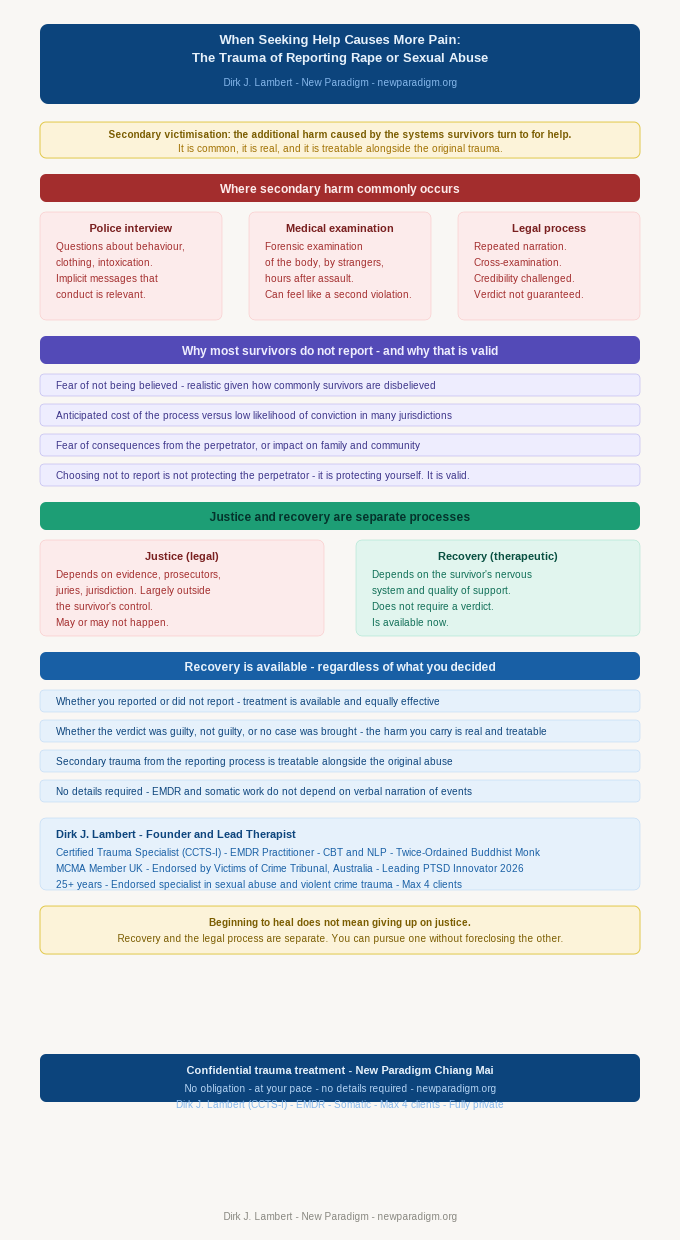
Many survivors of rape and sexual abuse describe a moment when they made the decision to report - and discovered that the act of seeking justice or recognition could itself become a source of significant harm. Police interviews that felt like interrogations. Medical examinations that required them to submit their bodies, again, to strangers. Legal processes that put their character, their credibility, and their most private experiences under public scrutiny. The discovery that the person who harmed them faced no consequence while they faced repeated demands to prove what happened.
This is not an unusual experience. It is common enough that clinicians have a name for it: secondary victimisation - the additional harm caused to survivors by the systems and processes they turn to for help. It does not mean those systems are always harmful, or that reporting is never the right choice. It means that for many survivors, reaching out to external institutions for help has come at a significant personal cost - and that this cost deserves to be acknowledged honestly, without pressure in any direction.
This article is for survivors who have been harmed by the process of reporting, survivors who are considering whether to report and want to understand what that may involve, and survivors who have chosen not to report and carry uncertainty about that decision. All of those positions are valid. The purpose here is not to advise on whether to report. It is to acknowledge the reality of what many survivors face when they do - and to be clear that help and recovery are available regardless of what you decide.
What Secondary Victimisation Looks Like
Secondary victimisation occurs when the responses of individuals or institutions to a survivor's disclosure add to the harm already caused by the original abuse. It takes many forms, and not all of them are dramatic. Some are the result of systemic failures. Others are the result of individual insensitivity. All of them share a common impact: the survivor who reached out for help leaves the encounter feeling more damaged, more ashamed, less believed, or less safe than before they disclosed.
Police interviews can be a significant source of secondary harm, particularly when conducted by officers without specialist training in sexual trauma. Questions that focus on the survivor's behaviour - what they were wearing, why they were in that location, whether they fought back, whether they had been drinking - communicate, explicitly or implicitly, that the survivor's conduct is relevant to whether what happened was wrong. It is not. But the message that it is can embed itself deeply in a survivor who was already carrying shame and self-blame.
Medical examinations conducted shortly after a sexual assault - forensic examinations designed to collect evidence - require the survivor to submit to a physical examination of the most intimate areas of their body by a medical professional they have not met before, under clinical conditions, often within hours of a violent or overwhelming experience. For many survivors, this examination is experienced as a second violation - not because of anything the medical professional does wrong, but because the body is still in shock and the examination requires submission and exposure that the nervous system has not yet had the capacity to consent to meaningfully.
The legal process, for cases that reach prosecution, involves its own category of potential harm. Having to give detailed verbal accounts of the assault, sometimes repeatedly, across police interview, legal preparation, and courtroom testimony - and then to have that account tested, challenged, and scrutinised in cross-examination - can produce the kind of reactivation and overwhelm that clinical practice describes as retraumatisation. The courtroom is not a therapeutic environment. It is an adversarial one. And an adversarial environment is precisely the wrong context in which to be required to narrate the worst experience of your life.
Not being believed - by police, by prosecutors, by a jury, or by people in the survivor's own life - is one of the most devastating outcomes of disclosure. It compounds the original harm with a second one: the conclusion that the experience was not real, not serious, or not the survivor's to claim. For survivors who already struggle with self-doubt about what happened, institutional disbelief can confirm the worst version of their internal narrative.
Why So Many Survivors Choose Not to Report
The majority of rapes and sexual assaults are not reported to the police. This is not a failure of courage or civic responsibility on the part of survivors. It is a rational response to an accurate assessment of risk.
Survivors who do not report do so for reasons that are consistent and well-documented: fear of not being believed, anticipated shame and humiliation in the legal process, not wanting to have to describe what happened in detail to strangers, fear of consequences from the perpetrator, concern about the impact on their family or community, and an awareness - often accurate - that prosecution is unlikely even if they do report. In many jurisdictions, conviction rates for rape and sexual assault remain very low. The gap between the harm of going through the reporting and legal process and the likelihood of any outcome that resembles justice is, for many survivors, too large to justify the cost.
Choosing not to report is not giving the perpetrator permission. It is not protecting them. It is a decision made under conditions of significant pressure by a person who has already been harmed, weighing risks and costs with the information available to them. That decision deserves respect - not encouragement to reconsider in either direction, and not judgment.
When Reporting Has Already Caused Harm
For survivors who went through the reporting process and found it harmful - who were disbelieved, whose cases were not pursued, who endured the legal process and found no justice at its end, or who simply experienced the act of disclosure to institutions as retraumatising - there can be a particular kind of injury to carry alongside the original abuse.
It is an injury that compounds the original message of the abuse - that what happens to you does not matter, that your body is not your own to protect, that there is no safe place to bring what was done to you - with an additional confirmation from the institutions that were supposed to provide redress. For some survivors, the experience of going through the system and emerging more harmed than helped is itself a traumatic event that requires specific processing.
This is not a reason not to have reported. It is a reality that deserves to be held with the same care as the original abuse. The harm caused by secondary victimisation is real, and it is treatable alongside the original trauma.
The Difference Between Justice and Recovery
There is an important distinction worth drawing - not to diminish the pursuit of justice, but to separate it from the pursuit of healing, because for many survivors these two things can become entangled in ways that delay or complicate recovery.
Justice, in its legal sense, depends on external circumstances: the availability of evidence, the decisions of prosecutors, the composition of juries, the effectiveness of legal representation, the specific laws of the jurisdiction. It is, fundamentally, outside the survivor's control. Recovery is not. Recovery depends on the survivor's own nervous system and the quality of the support they receive in processing what happened. It does not require a conviction. It does not require the perpetrator to acknowledge what they did. It does not require anyone else to validate that the harm was real.
Many survivors, particularly those whose attempts to access justice have been unsuccessful, find themselves unable to begin recovery while they are still waiting for the external validation that justice would provide. The case is still open, or still hoped for, and beginning to heal feels like it means accepting that what happened was acceptable, or abandoning the fight for recognition. It is not. Recovery and justice are separate processes, and pursuing one does not foreclose the other. Beginning to heal does not mean giving up.
Recovery Is Available Regardless of Whether You Have Reported
This is perhaps the most important thing to say clearly: access to effective trauma treatment is not dependent on having reported the abuse, having gone through the legal process, having been believed by external institutions, or having achieved any outcome in relation to the perpetrator. What happened to you is the basis for treatment. Nothing else is required.
At New Paradigm, the pre-admission conversation is confidential. What you share goes no further. There is no requirement to have reported what happened or to intend to report it. There is no obligation to disclose the details of the abuse - because, as explained in detail elsewhere, the treatment modalities used do not require verbal narration of the traumatic event. EMDR works at the level of the nervous system. Somatic practices work at the level of the body. Neither requires you to produce an account for institutional purposes.
If the reporting process itself has been part of your experience - if the police interview, the medical examination, the legal process, or the outcome of that process has added to what you are carrying - that is treatable material in its own right. The secondary trauma of institutional failure or of being disbelieved can be processed alongside the original abuse. You do not have to have it resolved or accepted before you can begin.
Understanding why survivors respond the way they do during abuse is often part of the process of addressing the shame and self-doubt that the reporting system can amplify. A practical guide to finding the right professional help covers what to look for in a therapist and what the first contact actually involves. And the capacity for healthy relationships - which can feel very far away for survivors who have been harmed both by abuse and by the institutions they turned to - is something that therapeutic work can genuinely restore.
If what you have carried includes not just what was done to you but what happened when you tried to get help - you are not alone in that, and both can be worked with. Contact New Paradigm for a confidential conversation, at your own pace, with no obligation to disclose more than you choose.
About the Author
Dirk J. Lambert is the founder and lead therapist at New Paradigm, a private mental health retreat in Chiang Mai, Thailand. He is a Certified Trauma Specialist (CCTS-I), EMDR practitioner, CBT and NLP specialist, and twice-ordained Buddhist monk with more than 25 years of clinical experience working with complex trauma, PTSD, depression, and attachment disorders. Dirk founded Thailand's first alternative recovery centre in 2000 and established New Paradigm in 2014. He is a recognised specialist in the treatment of sexual abuse survivors, an endorsed provider through the Victims of Crime Assistance Tribunal in Melbourne, Australia, a member of the Complementary Medical Association UK (MCMA), and was named Leading PTSD Innovator in 2026 by Global Health and Pharma. He works personally with every client who enters the programme.