You are 44. You walk into a meeting room and two colleagues by the window laugh at something on a phone. Before you have had a single thought, your stomach drops, your face goes hot, and you are scanning the room for the exit. Part of you knows they are not laughing at you. The rest of you is twelve years old again, standing at the edge of the playground, waiting to find out what today will bring.
People who were bullied at school often carry it like this for decades: not as a memory they think about, but as a reaction they cannot stop. Most of them have been told, and have told themselves, that it was just children being children, that everyone got teased, that it was a long time ago. And yet the body still braces. This article answers the question many of them eventually type into a search bar late at night: can bullying cause PTSD? It explains why school bullying leaves such a deep mark, what the long-term effects of bullying look like in adults, why they are so often missed, and how bullying trauma is treated.
Can Bullying Cause PTSD?
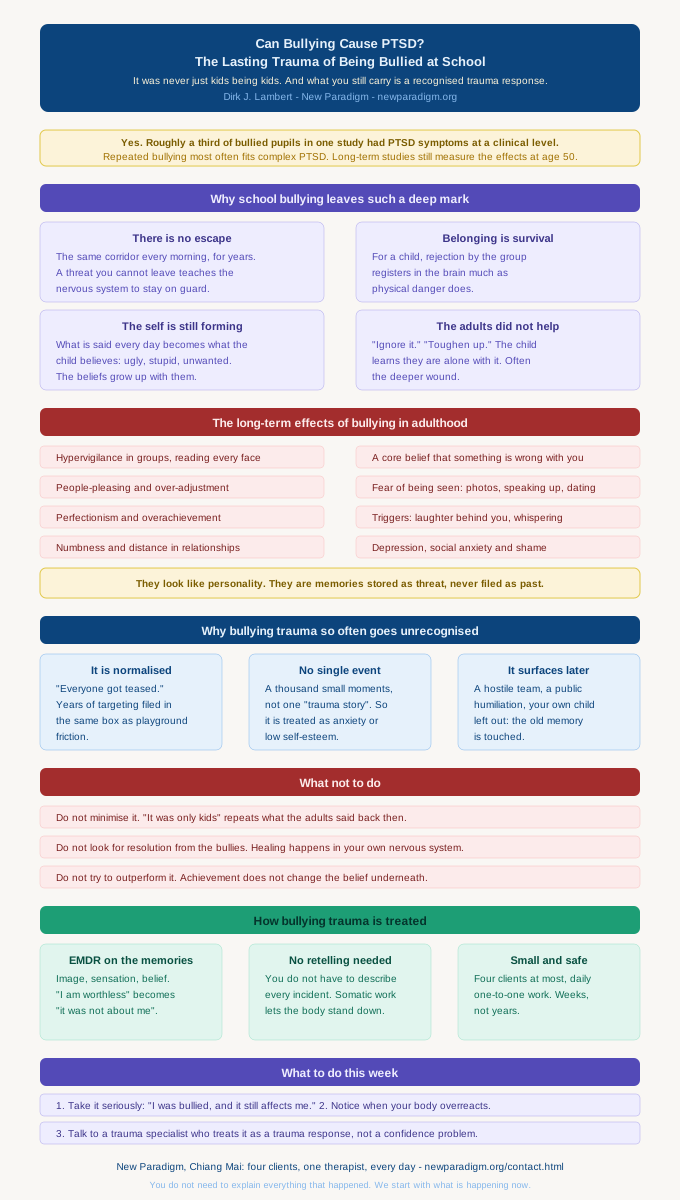
Yes. Bullying can cause PTSD, and more often it causes complex PTSD. Research on schoolchildren has found that a large share of bullied pupils, roughly a third in one Norwegian study, have post-traumatic stress symptoms at a level that would be considered clinical. Long-term studies that followed children into adulthood, in Britain and the United States, found that being bullied raised the risk of anxiety disorders, depression and suicidal thoughts years later, and that the effects were still measurable at the age of 50.
The reason it is so often doubted is that the classic definition of PTSD was built around a single, life-threatening event: an assault, an accident, combat. Much bullying does not look like that. It is a thousand smaller events, repeated for months or years, in a place the child cannot leave. That pattern fits complex PTSD, which the World Health Organization recognises as a separate diagnosis for trauma that is prolonged, repeated and hard to escape. It adds three things to the usual PTSD symptoms: difficulty regulating emotions, a deeply negative sense of self, and problems in relationships. Those three are, almost word for word, what adult survivors of bullying describe. The treatment of PTSD and complex PTSD is the same whether the cause was one terrible day or three terrible years, and it works for bullying trauma just as it does for any other.
If you want to understand the difference between the two diagnoses in more depth, I have written about how complex PTSD differs from PTSD separately. For the purposes of this article, the important point is simple. What happened to you was real, and the way it still affects you is a recognised trauma response, not a flaw in your character.
Why School Bullying Leaves Such a Deep Mark
Adults sometimes compare their own memories of being bullied to "real" trauma and conclude that they have no right to still be affected. That comparison misses what makes school bullying so damaging. Four features come together, and each one on its own is enough to leave a trace.
- There is no escape. A child cannot resign from school, move cities or stop seeing the people who hurt them. They have to walk back into the same corridor every morning, often for years. A threat you cannot leave is the condition under which the nervous system learns to stay permanently on guard.
- It happens when belonging is survival. For a child and especially for a teenager, acceptance by the group is not a pleasant extra. It is wired in as a matter of safety. Being rejected, mocked or isolated by peers registers in the brain much as physical danger does.
- It shapes the self while the self is still forming. Adults who are insulted can usually set the insult against everything else they know about themselves. A child cannot. What is said to them every day becomes what they believe about themselves: that they are ugly, stupid, disgusting, unwanted. These beliefs do not stay at school. They grow up with the child.
- The adults often did not help. Many survivors told a teacher or a parent and were told to ignore it, to toughen up, or to stop being so sensitive. Some never told anyone, because they were ashamed or knew it would make things worse. Either way, the child learned that they were alone with it. That second wound, of not being protected, is often the deeper one.
Online bullying has removed the last refuge many children used to have. When the messages and the group chats follow a child home, into the bedroom and onto the phone under the pillow, there is no hour of the day when the nervous system can stand down.
The Long-Term Effects of Bullying in Adulthood
The long-term effects of bullying rarely look like the dramatic flashbacks people associate with PTSD. They look like personality. That is why so many adults never connect them to what happened at school. In my clinical work, these are the patterns I see most often in people who were bullied as children:
- Hypervigilance in groups. Constantly reading faces, tones and laughter for signs of mockery or rejection. Arriving early to choose a seat by the wall. Exhaustion after any social event.
- A core belief that something is wrong with you. Not a thought you have, but a feeling you live inside: that you are fundamentally less acceptable than other people, and that sooner or later they will see it.
- People-pleasing and over-adjustment. Agreeing, accommodating, never asking for anything, so that no one has a reason to turn on you.
- Fear of being seen. Avoiding photographs, speaking up, promotion, dating, anything that would make you visible and therefore a target.
- Perfectionism and overachievement. Making yourself so competent that no one could ever find fault again. It often works, and from the outside it looks like success.
- Specific triggers. Laughter behind you, whispering, being left out of a conversation, a nickname, the smell of a school canteen, the sound of a changing room. The reaction is instant and far bigger than the situation.
- Numbness or withdrawal. Keeping people at a distance, feeling flat in relationships, not quite trusting anyone with the real you. Numbness and detachment from loved ones are among the most common and least recognised effects.
- Depression, anxiety and shame. Low mood that never fully lifts, social anxiety, and a deep reluctance to admit that something so "ordinary" still hurts.
Underneath all of these sits the same mechanism. During the years of bullying, the brain stored a great many moments of humiliation and fear as threat, with the beliefs that came with them: I am worthless, I am not safe with people, I am on my own. Those memories were never filed as past. When something in the present resembles them, even slightly, the body reacts as if the danger is happening now. This is why a joke you were not part of can feel like it is happening all over again.
Why Bullying Trauma So Often Goes Unrecognised
Adults who come to me with the trauma of being bullied have usually spent years being treated for something else: anxiety, depression, burnout, relationship problems, low self-esteem. The bullying is mentioned in passing, if at all. There are several reasons for this.
Bullying is culturally normalised. Almost everyone was teased at some point, so the experience of a child who was systematically targeted for years gets filed in the same box as ordinary playground friction. Survivors minimise it themselves, partly out of shame and partly because admitting how much it still hurts feels like proof that the bullies were right about them. And because there is often no single, dramatic event, the person does not have a "trauma story" in the form that doctors and therapists are used to hearing.
Timing plays a part too. Many people functioned well for years, sometimes decades, and only began to struggle when something in adult life echoed the old situation: a team that turned against them, a manager who humiliated them in public, their own child being excluded at school. This is a delayed trauma response, and it is common after bullying. It is not a sign that the person is overreacting to something small. It is a sign that something old, which was contained for a long time, has been touched.
Bullying also often travels with other childhood difficulties. Children who were already unsafe at home, who were different, who were neurodivergent, or who had been sent away to boarding school were more likely to be targeted and less likely to be protected. In treatment, the bullying memories and the earlier wounds are often linked, and they are worked with together.
What Not to Do
Three responses are understandable, and all three tend to keep bullying trauma in place.
The first is minimising it. "It was only kids." "Others had it worse." "I should be over this by now." Every time you say this to yourself, you repeat what the adults around you said back then: that it did not matter enough to be taken seriously. The nervous system hears it as one more confirmation that you are on your own with it.
The second is looking for resolution from the people who hurt you. Some survivors track down former bullies on social media, hoping for an apology or at least an acknowledgement. Occasionally it brings relief. More often the other person barely remembers, or laughs it off, and the old wound is reopened by the same person. Healing does not depend on what they say or do. It happens in your own nervous system.
The third is trying to outperform it. More achievement, more control over your appearance, more effort to be liked. It can build an impressive life, but it does not change the belief underneath, and it is exhausting. Many people who arrive at New Paradigm with burnout discover that the engine driving them was the twelve-year-old still trying to make sure it never happens again.
How Bullying Trauma Is Treated
The good news is that bullying trauma responds very well to treatment, including when it is decades old. The memories are usually clear, the beliefs attached to them are easy to name, and the adult who comes to therapy has resources the bullied child never had.
EMDR is the method I rely on most. It works directly on the stored memories: the specific moments of humiliation and fear, the image, the sensation in the body, and the belief that came with them. As each memory is processed, the brain completes the filing it could not do at the time. The memory remains, but it stops being a live threat, and the belief changes from "I am worthless" to something closer to "I was a child being treated badly, and it was not about me." Clients often describe it as finally being able to look back at that child with compassion instead of shame.
There is no need to retell every incident in detail. You do not have to talk about your trauma in detail for EMDR to work, which matters for survivors of bullying, many of whom feel ashamed of what was said and done to them. Alongside the memory work, treatment addresses the present: the nervous system's alarm in groups, the people-pleasing, the fear of being seen. Somatic work helps the body learn that it can stand down.
For many adults, a small, safe setting is part of the healing in itself. At New Paradigm there are never more than four clients at a time, and every session is one to one. That is why I built the programme the way I did: daily individual work, intensive enough that the old memories can be processed in weeks rather than years, in a place where nobody is watching to see if you fit in.
What to Do This Week
If you recognise yourself in this article, three steps are worth taking now:
- Take it seriously. Say it to yourself in plain words: "I was bullied, and it still affects me." Not "it was nothing", not "I am too sensitive". The acknowledgement you did not get then can start with you.
- Notice your triggers. For one week, write down the moments when your body reacts more than the situation warrants: the laughter, the group, the feeling of being left out. You are not trying to fix them yet. You are making the link between past and present visible.
- Talk to a trauma specialist. Not someone who will tell you to build your confidence, but someone who understands that what you carry is a trauma response and knows how to treat it.
If you are ready for that conversation, contact New Paradigm. You do not need to explain everything that happened. We will start with what is happening now, and decide together whether intensive treatment is the right next step.
About the Author
Dirk J. Lambert is the founder and lead therapist at New Paradigm, a private mental health retreat in Chiang Mai, Thailand. He is a Certified Trauma Specialist (CCTS-I), EMDR practitioner, CBT and NLP specialist, and twice-ordained Buddhist monk with more than 25 years of clinical experience working with complex trauma, PTSD, depression, and attachment disorders. Dirk founded Thailand's first alternative recovery centre in 2000 and established New Paradigm in 2014. He is a recognised specialist in the treatment of sexual abuse survivors, an endorsed provider through the Victims of Crime Assistance Tribunal in Melbourne, Australia, a member of the Complementary Medical Association UK (MCMA), and was named Leading PTSD Innovator in 2026 by Global Health and Pharma. He works personally with every client who enters the programme.