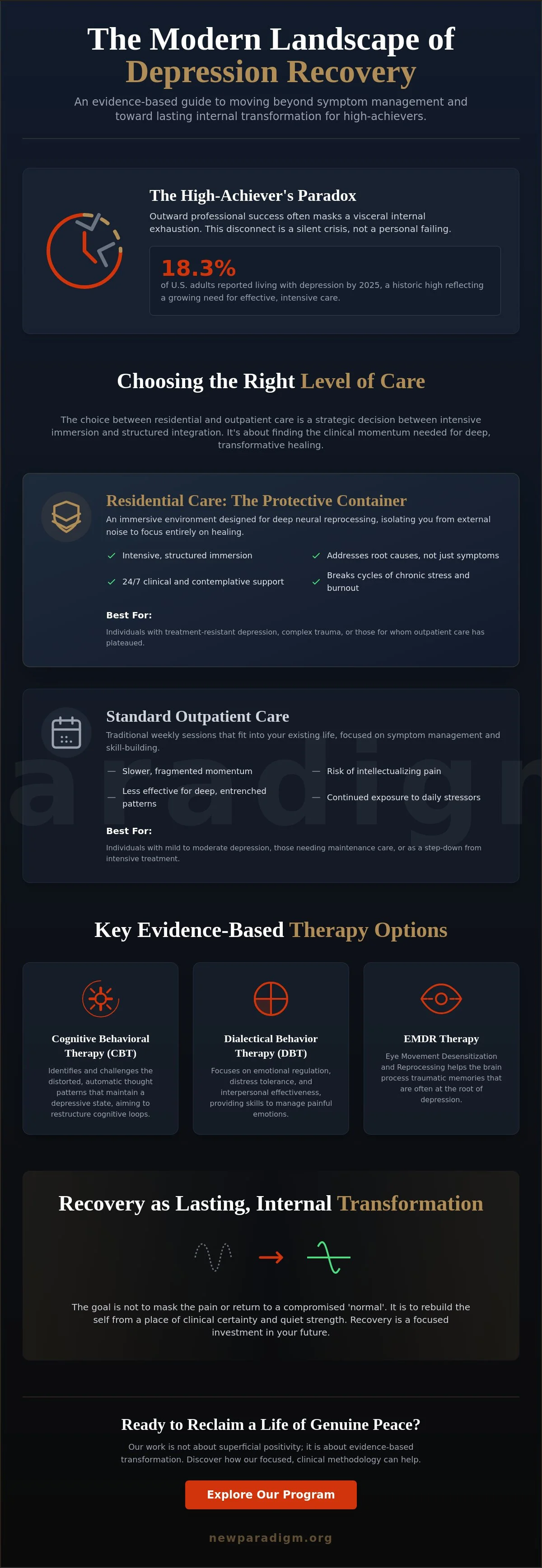
You've reached the peak of your professional career; yet the internal collapse you feel every morning suggests a foundation that's quietly giving way. It's a heavy, silent exhaustion that persists despite your external achievements. You've likely spent years intellectualizing your pain, explaining it away as the cost of high performance. You aren't alone in this struggle. By 2025, 18.3% of U.S. adults reported living with depression, a historic high that reflects a growing crisis of the spirit. You may fear that this state is permanent, but that's a symptom of the condition, not a fact of your future. Understanding your depression therapy options is the first step toward dismantling that fear.
This clinical guide helps you move through the modern landscape of recovery to find a path toward lasting internal transformation. We'll move past superficial management techniques to explore intensive, evidence-based recovery models. You'll learn about clinical frameworks that make sense of your struggle and the private, protective environments designed for deep neural reprocessing. We'll examine how specialized programs, from residential trauma work to EMDR, provide the structure needed to reclaim a life of genuine peace. Recovery is not about masking the pain; it's about rebuilding the self from a place of clinical certainty and quiet strength.
Key Takeaways
- Identify why outward professional success often masks a visceral internal exhaustion, requiring a shift from intellectualized explanations to deep psychological work.
- Compare evidence-based depression therapy options to find the specific clinical framework that addresses the root of your suffering rather than just managing symptoms.
- Reframe the choice between residential and outpatient care as a strategic decision between intensive immersion and the often fragmented nature of traditional therapy.
- Explore the concept of a protective container, where clinical authority and contemplative traditions create the necessary isolation for intensive neural reprocessing.
- Learn to view recovery not as a temporary pause in your life, but as a focused investment in a lasting, internal transformation.
Beyond the Surface: When Standard Depression Treatments Feel Insufficient
You carry a visceral fatigue that no amount of rest seems to touch. It's a heavy, internal collapse that exists right alongside your professional success. This disconnect is common among high-achievers who have mastered the art of looking well while feeling hollow. In 2026, data from the Substance Abuse and Mental Health Services Administration indicates that over 23.1% of U.S. adults, or roughly 59.3 million people, live with a mental illness. For many in your position, the pain is intellectualized; you can explain why you feel this way, but the explanation doesn't provide relief. When standard depression therapy options focus only on managing symptoms, they fail to reach the deep-seated architecture of your suffering.
To better understand why traditional methods might feel insufficient for your specific needs, watch this helpful video:
Superficial management techniques often skip over the root causes of your distress. This isn't a failure of your will; it's a limitation of the tools you've been given. When depression becomes treatment-resistant, it requires a shift from maintenance to intensive intervention.
The Limitations of the Traditional Medical Model
A standard 50-minute weekly session often lacks the momentum needed for deep, transformative healing. It's easy to fall into the intellectualization trap, where you use your intelligence to talk around the pain rather than moving through it. While a comprehensive overview of depression treatments includes many valid outpatient paths, these often lack the intensity required for complex cases. You need a protective environment that isolates you from external noise. This isn't a luxury; it's a clinical necessity for those whose depressive cycles have become entrenched.
Identifying the Need for Intensive Intervention
You might notice that your current outpatient care no longer provides the stability it once did. Perhaps your progress has plateaued, or the burnout from your career is actively fueling your depressive state. Chronic stress doesn't just exhaust the body; it rewires the brain's ability to regulate mood. When the gap between your external life and internal reality becomes a chasm, it's a sign that you need a more focused level of care. Our Depression Treatment Program at New Paradigm Mental Health Retreat is designed to provide that focus. We are compassionate realists who accept the somber depth of your struggle while providing the precise, clinical methodology required to navigate through it. Our work is not about superficial positivity; it is about evidence-based transformation within a strictly limited and intentional capacity.
When traditional depression therapy options no longer provide stability, moving toward a residential or specialized outpatient framework can offer the momentum needed for a lasting internal shift.
A Roundup of Evidence-Based Depression Therapy Options
Selecting a path toward recovery isn't about following the latest wellness trend. It's about engaging with evidence-based depression therapies that have the power to alter neural architecture. We don't seek to merely manage your mood; we aim to resolve the underlying physiological distress that keeps you tethered to exhaustion. Understanding your depression therapy options requires a look at how different modalities impact the brain's ability to regulate emotion and process lived experience.
Cognitive and Behavioral Interventions (CBT & DBT)
Cognitive Behavioral Therapy remains a standard in clinical settings for a reason. It identifies the distorted, automatic thought patterns that maintain a depressive state. By challenging these cognitive loops, you can begin to shift the prefrontal cortex's influence over your emotional state. Dialectical Behavior Therapy adds a necessary layer of emotional regulation. It teaches you to sit with intense distress without collapsing into old coping mechanisms. While these are foundational, they often stay at the cognitive level. For those with complex, high-functioning depression, these tools may require supplementation to reach deeper layers of the psyche.
Reprocessing the Past: EMDR and Trauma-Informed Care
A critical gap in many recovery models is the failure to address the intersection of trauma and depression. Often, what feels like a lack of motivation is actually a persistent trauma response. Eye Movement Desensitization and Reprocessing (EMDR) doesn't ask you to endlessly talk about your past. Instead, it uses bilateral stimulation to desensitize the traumatic memories that fuel your current despair. This represents a fundamental clinical shift. It moves from asking "what is wrong with you" to understanding "what happened to you." Our intensive EMDR therapy sessions facilitate rapid reprocessing, providing a level of momentum that standard weekly appointments simply can't achieve.
These depression therapy options work by targeting the limbic system and re-establishing the brain's natural processing capacity. It's a matter of rewiring neural pathways, not just discussing symptoms. If you're ready to move beyond management and toward a genuine internal shift, you might speak with a clinical specialist about a tailored recovery plan. We value depth over scale, ensuring that your path to recovery is as intentional and focused as the life you've built.
Residential vs. Outpatient: Choosing the Right Level of Care
You might feel that you cannot afford to step away from your responsibilities; yet, the truth is that you cannot afford to continue the cycle of fragmented care. Standard outpatient care is often a series of hour-long interventions separated by days of intense professional pressure. This structure frequently fails to gain ground because it asks you to heal in the same environment that maintains your distress. When evaluating your depression therapy options, consider the difference between maintenance and resolution. A residential stay is not a retreat from life. It is a strategic investment in the foundation of your future.
By removing the constant vibration of professional demands and household expectations, you allow your nervous system the space to actually respond to clinical work. This isolation from external triggers is essential for those experiencing the internal collapse of high-functioning depression. It provides a protective container where the only focus is your recovery. A strictly limited capacity in a facility is not about exclusivity for its own sake. It is about ensuring the clinical depth and individual focus required for lasting transformation. You can find more details on choosing the right level of care through clinical diagnostic frameworks.
The Case for Intensive Residential Treatment
Our Residential Trauma Treatment Program provides a level of psychological safety that outpatient settings simply cannot match. Within this environment, 24/7 clinical support accelerates the recovery timeline by providing immediate stabilization when difficult emotions surface. We don't just focus on talk therapy. We integrate somatic healing to address the physical weight of depression, helping you reconnect with a body that has likely felt like a burden for years. This immersive approach allows for a momentum in healing that weekly appointments cannot replicate.
Evaluating Treatment Quality and Standards
It's vital to distinguish between a leisure spa and a clinical recovery center. A boutique facility should be defined by its staff-to-client ratio and the specific credentials of its practitioners, not just its aesthetic. True recovery requires a structured environment and a robust Aftercare Program to ensure long-term stability once you return to your professional life. We are not a place for general leisure; we are a dedicated environment for intensive internal work. If you're ready to move beyond the surface of your struggle, reach out to our clinical team to discuss a path forward that honors the gravity of your experience.
The New Paradigm: Integrating Clinical Excellence with Peace
At New Paradigm Mental Health Retreat, we don't believe in the sterile atmosphere of traditional clinics; nor do we offer the superficial distractions of a leisure spa. Our philosophy is a deliberate blend of clinical authority and contemplative traditions. We provide a protective container where intensive psychological work can happen without the interruption of your daily responsibilities. This is where you move from managing a condition to undergoing a lasting internal transformation. It's a space designed for those who have exhausted traditional outpatient routes and require a more immersive clinical experience. Many high-achievers find that our burnout recovery program serves as a vital parallel path, addressing the specific exhaustion that comes from years of sustained high performance.
Our Personalized Depression Treatment Program
Our program is not a standardized curriculum. We recognize that your depression therapy options must be as nuanced as your own history. We combine intensive EMDR, evidence-based clinical therapy, and somatic work to address the body's stored distress. By limiting our capacity intentionally, we ensure that every individual receives bespoke care from practitioners who have the time to understand the depths of their struggle. This limited capacity is a shorthand for quality and individual focus. We explicitly reject superficial management techniques in favor of deep, internal transformation that addresses the root cause of your pain.
Why Chiang Mai for Mental Health Recovery?
Recovery requires a shift in perspective that is often difficult to achieve in the same environment where your pain was forged. The natural beauty and spiritual calm of Northern Thailand provide a unique backdrop for this work. Our mental health facility in Thailand offers an environment where external noise is replaced by a grounded, restorative silence. This isn't about escaping your life. It's about stepping into a space where you can finally hear yourself. We invite you to step away from the noise and begin the internal journey toward a foundation that will actually hold your weight. This journey is supported by decades of clinical practice and a commitment to your specific path of recovery.
Reclaiming the Foundation of Your Life
You don't have to settle for a life of managed exhaustion or the silent weight of unhealed pain. We've explored how standard treatments often fail high-functioning individuals and why intensive, trauma-informed reprocessing is essential for deep transformation. Navigating your depression therapy options is a strategic choice about the trajectory of your future. It requires moving beyond intellectualized understanding toward a visceral, clinical resolution of the root cause. This is a journey of reclaiming the self from the architecture of despair.
At New Paradigm Mental Health Retreat, we offer a protective container for this work, founded by mental health professionals with decades of clinical experience. Our strictly limited capacity ensures that your recovery remains our singular, personalized focus. We utilize evidence-based EMDR and trauma-informed modalities to facilitate a recovery that is as profound as it is lasting. It's time to step away from the noise and begin the work that actually holds your weight. Explore our private Depression Treatment Program in Chiang Mai and discover the path to a life rebuilt on peace and clinical certainty. You have the capacity for transformation; we provide the methodology to reach it.
Frequently Asked Questions
What is the most effective therapy for treatment-resistant depression?
The most effective path for treatment-resistant depression often involves an intensive integration of EMDR, somatic therapy, and clinical intervention. Standard 50-minute sessions often fail to reach the deep depressive architecture of high-achievers. By utilizing a multi-layered approach, we target the limbic system to resolve the visceral fatigue that traditional medication and talk therapy may leave untouched. This isn't about management; it's about neural reprocessing and lasting change.
How does residential depression treatment differ from a psychiatric hospital?
Residential treatment is a personal environment for intensive internal work, whereas a psychiatric hospital focuses primarily on medical stabilization and immediate safety. We are not a clinical ward designed for crisis management. Instead, we provide a protective container where you can engage in deep psychological work without the noise of an institutional setting. This distinction is vital for those seeking a premium, focused space for recovery.
Can EMDR therapy help with depression if I don't have a single major trauma?
EMDR therapy is exceptionally useful for depression even in the absence of a single, major traumatic event. It's often the cumulative weight of chronic stress and intellectualized pain that fuels a depressive collapse. By desensitizing these layered memories, you can resolve the physiological distress that keeps your nervous system in a state of exhaustion. It's a method for clearing the internal debris that blocks your path to peace.
How long does a typical intensive depression treatment program last?
A typical intensive depression treatment program generally spans thirty to sixty days to ensure deep, sustainable healing. This duration provides the necessary isolation from external triggers and workplace noise. It allows enough time for the brain to move out of a state of survival and into a state of active reprocessing. Short-term stays may provide temporary relief, but lasting transformation requires this level of clinical momentum.
What should I look for when choosing a depression therapy option abroad?
Look for a facility that offers a strictly limited capacity and clear clinical authority when choosing depression therapy options abroad. You should avoid programs that feel like general leisure spa stays. Instead, focus on the specific therapeutic modalities offered, such as EMDR or trauma-informed care. The goal is to find an environment that balances professional expertise with the spiritual calm of a location like Chiang Mai.
Is aftercare included in residential depression programs?
An integrated Aftercare Program is essential for maintaining the progress made during residential treatment. We don't believe recovery is a finished state once you step outside our doors. It's a continuous process that requires a structured clinical framework for reintegration. A quality program will provide a clear roadmap for long-term stability, ensuring that the internal shifts you've achieved remain resilient against the pressures of your professional life.
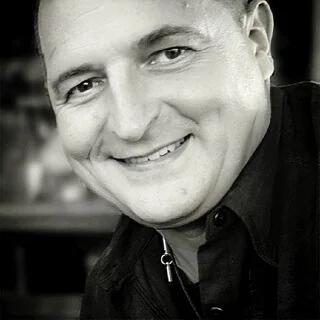
Article by
Dirk J. Lambert (MSc. - CCTS-I)
Dirk J. Lambert is a Licensed Psychotherapist, Mentor, Author, and Certified Trauma & EMDR Specialist with more than 25 years of experience helping people recover from trauma, depression, burnout, emotional abuse, and long-standing unresolved pain. His work is known for being direct, compassionate, and highly practical.
A twice-ordained Buddhist monk, Dirk bridges clinical trauma care with mindfulness, discipline, self-observation, and deep emotional honesty. He does not hide behind jargon, labels, or unnecessary complexity. He listens carefully, speaks plainly, and works toward meaningful change.
New Paradigm reflects the philosophy he has built over decades: intentionally small, deeply personal, private by design, and focused on what actually helps people recover from the inside out rather than simply cope more elegantly.