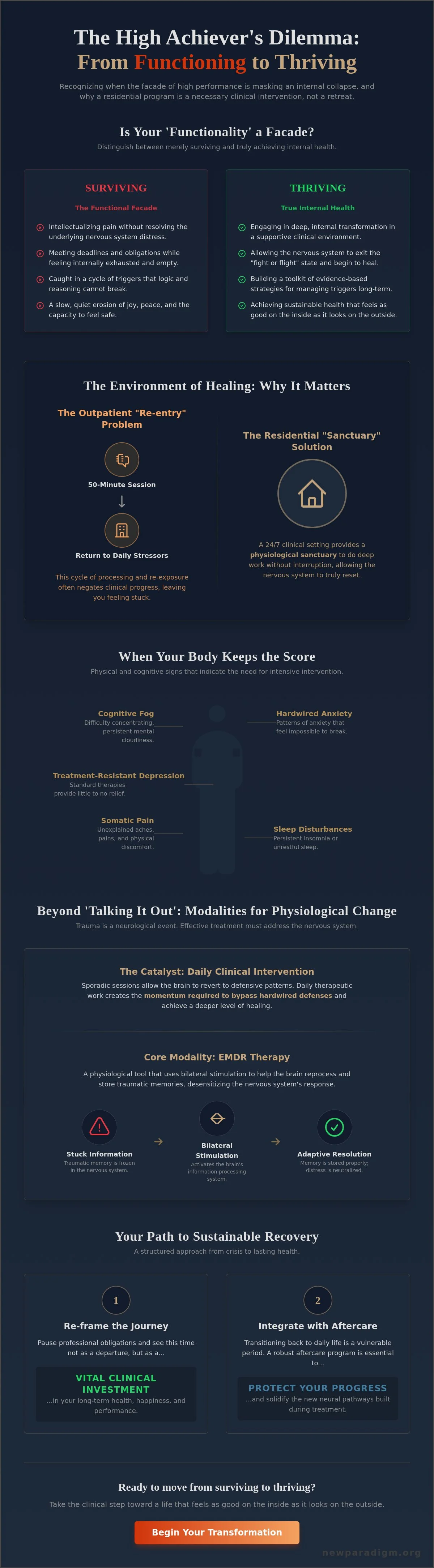
What if the "functional" life you've worked so hard to maintain is actually the very thing preventing your recovery? You've likely spent years intellectualizing your pain, explaining away the trauma, and convincing yourself that as long as the output remains high, you're fine. But you know the internal truth. Your body is exhausted, and your mind is caught in a cycle of triggers that no amount of logic can break. Choosing a residential mental health program is not a retreat into a leisure spa, nor is it a surrender to a sterile, hospital-like setting. Instead, it's a clinical intervention designed to provide a physiological sanctuary where the work of deep, internal transformation can finally begin.
We understand the weight of maintaining a facade while feeling an internal collapse. This guide offers a clinical perspective on navigating an intensive recovery journey for trauma and burnout. You'll learn how to select a program that aligns with the latest person-centered standards, what to expect during a physiological reset, and how to build a toolkit of evidence-based tools for managing triggers. We'll walk through the transition from crisis to sustainable health; ensuring you have a clear path toward a life that feels as good on the inside as it looks on the outside.
Key Takeaways
- Distinguish between maintaining a "functional" facade and achieving true internal health to determine if a residential mental health program is the necessary clinical step for your recovery.
- Understand the science behind a physiological reset and why somatic, daily clinical interventions are more effective for trauma than sporadic talk therapy.
- Gain practical strategies for pausing professional obligations and re-framing your time in treatment as a vital clinical investment rather than a departure.
- Identify the core elements of a robust aftercare program designed to protect your progress during the vulnerable transition back to daily life.
Recognizing the Need: When is a Residential Mental Health Program Necessary?
High achievers often master the art of the functional facade. You may still be meeting deadlines, attending social events, and managing a household, but the internal cost is becoming unsustainable. Chronic trauma does not always manifest as an obvious crisis. Often, it looks like a slow, quiet erosion of your capacity to feel joy, peace, or even basic safety. When you are merely functioning, you are surviving. Thriving requires a different level of intervention.
A residential mental health program provides the necessary distance from the triggers of your daily environment. It is a 24-hour clinical setting designed for intensive psychological work, distinct from the sterile atmosphere of a traditional hospital. This Residential Treatment Center model focuses on creating a physiological sanctuary. It allows your nervous system to finally exit a state of permanent fight or flight, providing the quiet required for deep internal work.
To better understand how these environments function, watch this helpful video:
The Limits of Traditional Outpatient Therapy
Weekly talk therapy sessions are often insufficient for deep seated C-PTSD or severe burnout. The re-entry problem is a significant barrier to healing. You spend fifty minutes processing a core wound, only to immediately return to the very stressors that caused the injury. This cycle frequently negates clinical progress. If you feel stuck in this loop, you might find more clarity in Choosing Residential Care vs. Outpatient Therapy to understand why a change in environment is vital.
Clinical Indicators for Intensive Intervention
When depression becomes treatment resistant or anxiety patterns feel hardwired, your body begins to keep the score. You might notice persistent sleep disturbances, a heavy cognitive fog, or somatic pain that no physician can explain. These are signs of a hidden collapse. A residential mental health program offers a safety net for deep trauma reprocessing that your home life simply cannot provide. It's about moving from a state of survival into a space where sustainable health is the primary focus, not a secondary thought.
Evaluating Clinical Modalities: Beyond Talk Therapy
For many high achievers, the primary barrier to healing is the tendency to intellectualize pain. You can explain your trauma, categorize your stressors, and map your childhood with clinical precision. Yet, the internal sense of collapse remains. This is because trauma is not just a story we tell; it is a neurological event. A residential mental health program shifts the focus from merely discussing the past to actively reprocessing how that past lives in your nervous system today. This is not a space for passive observation. It is a laboratory for internal change.
Intensity is the catalyst for this transformation. In traditional settings, the week between sessions allows the brain to return to its default defensive patterns. Daily clinical intervention creates the momentum required to bypass these hardwired defenses. By engaging in therapeutic work every day, you prevent the "re-entry" stress from resetting your progress. This sustained focus allows for a depth of work that sporadic sessions cannot achieve. If you are ready to explore how these modalities can be tailored to your specific history, you may speak with a clinical coordinator to discuss your path.
The Role of EMDR in Intensive Recovery
Reprocessing traumatic memories requires more than logic. EMDR therapy sessions accelerate this process by using bilateral stimulation to help the brain move stuck information into long-term storage. EMDR is a physiological tool for desensitizing the amygdala. Within a residential mental health program, you have the safety of immediate clinical support after a session. You don't have to drive home or return to a high-pressure office while your nervous system is still integrating the work. This protective environment ensures that deep reprocessing leads to resolution rather than re-traumatization.
Somatic Healing and Burnout Recovery
Burnout is not just being tired. It is a state of physiological bankruptcy where the body has lost its ability to regulate stress. Specialized burnout recovery programs differ from generic wellness retreats because they address the "body memory" of chronic stress through clinical rigor. We combine evidence-based modalities like Somatic Experiencing with contemplative practices to restore the mind-body connection. This synergy provides a grounded path to stability, teaching you to recognize internal cues before they lead to another collapse.
How to Prepare for the Transition to Residential Care
Transitioning into a residential mental health program often triggers a sense of professional and personal panic. You worry about the projects left unfinished or the family roles left vacant. Re-frame this departure. You are not falling behind; you are repairing the foundation that allows you to lead. Without this clinical investment, the collapse you are currently managing will eventually become total. This is an intentional pause to ensure you can return to your life with a restored capacity for engagement.
Preparation involves more than logistics. It requires a communication diet. In the initial phase, minimizing external triggers is essential for the nervous system to settle. This means setting firm boundaries with colleagues and family. Unlike a traditional hospital, a boutique clinical environment encourages personal comfort. Pack items that ground you. Soft textures, familiar books, and comfortable clothing help create a sense of safety within the therapeutic space. You are creating a sanctuary, not entering a cell.
The Emotional Logistics of Leaving
Communicating your needs to others is an exercise in boundary setting. You don't owe every stakeholder a detailed clinical history. A simple statement regarding a medical leave of absence is sufficient. The psychological benefit of checking in to a dedicated healing space like New Paradigm is the immediate relief of no longer having to maintain the facade. You are finally in a place where your struggle is seen and supported by experts who understand the weight of your responsibilities.
Clinical Preparation and Assessment
Your journey begins with a comprehensive intake process. This is a collaborative psychological evaluation to map your history and current triggers. We move beyond surface symptoms to identify the root causes of your exhaustion. Setting realistic goals is vital. You might start with simple stabilization before moving into the deep work of reprocessing trauma. For a deeper look at the methodology, read our guide on What to Expect in a Trauma Treatment Program.
If you are ready to begin the intake process and discuss your specific needs, reach out to our clinical team today.
Sustainable Recovery: The Critical Role of Aftercare
The re-entry phase is the moment where clinical insights meet the friction of reality. It is the most vulnerable time in the recovery journey. While a residential mental health program provides a vital physiological sanctuary, the true test of healing occurs when you return to the environment that initially fostered your burnout. Without a structured plan, the noise of professional obligations and family stressors can quickly overwhelm a newly regulated nervous system. Recovery is not a destination you reach; it's a state of being you learn to protect.
A robust aftercare program acts as the essential bridge between the clinical intensity of treatment and the complexities of daily life. This phase combines remote support with local integration to ensure your progress remains stable. Think of it this way: aftercare is the clinical insurance policy for your residential investment. It ensures that the profound shifts you experienced during your stay aren't lost to the momentum of your old habits.
At New Paradigm, our approach focuses on ensuring the clinical progress made in Chiang Mai survives the return home. We help you build a "recovery toolkit" that translates residential insights into sustainable daily habits. This isn't about generic advice. It's about practical, somatic tools that allow you to recognize internal triggers before they escalate into a crisis. We prioritize a safe, steady transition that honors the depth of the work you've already completed.
Bridging the Gap Between Treatment and Daily Life
Successful re-entry requires a relapse prevention plan that accounts for your specific workplace and family dynamics. We coordinate ongoing outpatient support and group check-ins to provide a layer of accountability. You don't have to navigate the return to high-pressure environments alone. By maintaining a connection to clinical support, you can address stressors in real-time rather than letting them accumulate into a new state of collapse.
Long-Term Mental Health Stability
Stability means moving beyond simple symptom management toward a life of intentionality and peace. It involves redefining success so that your internal health is no longer sacrificed for external output. Periodic clinical tune-ups or focused workshops can help reinforce your foundation as you grow. Discover how our intensive trauma therapy provides the foundation for a sustainable future, allowing you to live with clarity and resilience.
Reclaiming Your Foundation for Lasting Health
Recovery is not about learning to manage your symptoms better; it's about a fundamental neurological shift. You've seen how a residential mental health program provides the physiological sanctuary needed to bypass intellectual defenses. By integrating specialized EMDR and somatic trauma interventions, you move beyond the "functional" facade toward a state of genuine internal peace. This journey requires a deliberate pause, a protective environment, and a structured bridge back to your daily life.
At New Paradigm, we provide a boutique, private clinical environment in Chiang Mai designed for this specific work. Our center was founded and is led by experienced mental health professionals who understand the unique internal conflicts of high achievers. We don't offer a generic escape; we provide the clinical depth required for deep, internal transformation. You've managed the silence for long enough. It's time to invest in a recovery that lasts.
Begin your journey to deep clinical recovery with New Paradigm. You don't have to navigate the path from crisis to sustainable health alone. A life of clarity and resilience is waiting for you.
Frequently Asked Questions
How long does a typical residential mental health program last?
A typical residential mental health program usually spans between 30 and 90 days. The specific duration depends on the complexity of your clinical history and the depth of the trauma being processed. While some stabilization can occur in shorter periods, deep neurological reprocessing often requires a sustained commitment to fully exit the survival patterns of the past.
Is a residential program different from a psychiatric hospital?
A residential program is fundamentally different from a psychiatric hospital. It is not a sterile, locked ward designed for acute stabilization of immediate danger. Instead, it's a personal, clinical environment where you engage in intensive internal work. We prioritize a premium, protective atmosphere that feels like a sanctuary rather than a medical institution.
Can I continue to work remotely while in a residential treatment program?
Continuing to work remotely is generally restricted to ensure the success of your recovery. A core part of the healing process is the communication diet, which minimizes external noise and triggers. Engaging with professional obligations during treatment often prevents the nervous system from fully exiting the fight or flight state required for deep somatic work.
What is the success rate of intensive trauma therapy compared to outpatient care?
Intensive trauma therapy often yields more sustainable results for complex cases than sporadic outpatient care. Daily clinical interventions prevent the re-entry problem, where the stress of home life negates therapeutic progress between weekly sessions. This immersive approach allows for a cumulative healing effect that outpatient models simply cannot replicate.
How much does a residential mental health program cost in 2026?
In 2026, the cost of a residential mental health program varies significantly based on clinical specialization and the environment. Industry averages for standard 30 day programs often range from $6,000 to $30,000, while executive or boutique programs can be higher. You should verify specific coverage details, as 2026 federal policy changes have impacted Medicaid and insurance parity enforcement.
Are residential programs effective for treatment-resistant depression?
Residential programs are highly effective for treatment-resistant depression because they provide a 24 hour clinical environment for intensive work. When weekly therapy fails, the daily synergy of EMDR, somatic experiencing, and professional support can break through chronic patterns. This level of care addresses the physiological roots of depression that outpatient settings often miss.
Article by
Dirk J. Lambert (MSc. - CCTS-I)
Dirk J. Lambert is a Licensed Psychotherapist, Mentor, Author, and Certified Trauma & EMDR Specialist with more than 25 years of experience helping people recover from trauma, depression, burnout, emotional abuse, and long-standing unresolved pain. His work is known for being direct, compassionate, and highly practical.
A twice-ordained Buddhist monk, Dirk bridges clinical trauma care with mindfulness, discipline, self-observation, and deep emotional honesty. He does not hide behind jargon, labels, or unnecessary complexity. He listens carefully, speaks plainly, and works toward meaningful change.
New Paradigm reflects the philosophy he has built over decades: intentionally small, deeply personal, private by design, and focused on what actually helps people recover from the inside out rather than simply cope more elegantly.