She was fourteen when he noticed her. He was older, generous, the only person who seemed to understand her. He bought her a phone, picked her up from school, told her she was mature for her age. Within a year he was asking her to "help him out" with his friends, and within two she was being sold several times a night, in flats she did not know, in cities she could not name. She got out at nineteen. Now in her thirties, she has a job, a flat, a cat. She also has nightmares, a body she cannot stand to be touched, a deep belief that she is worth nothing, and a story she has told almost nobody, because the few times she tried, she saw the look on their faces.
Survivors of child sexual exploitation and human trafficking carry one of the heaviest forms of trauma there is, and they are among the least likely to get the help they need. This article explains what this kind of trauma is, why it affects survivors so deeply, what its consequences look like in adult life, and how it can be treated, including what treatment looks like at New Paradigm.
What Child Sexual Exploitation and Trafficking Are
Child sexual exploitation is the use of a child for sex in exchange for something: money, drugs, food, a place to sleep, gifts, or the promise of love and protection. It used to be called "child prostitution". That term is no longer used by professionals or survivors, because it suggests a choice. A child cannot consent to being sold. Under international law, any child recruited, moved or held for sexual exploitation is a victim of trafficking, whether or not force, threats or deception can be shown. Trafficking does not require crossing a border. Many survivors were trafficked within their own country, their own city, sometimes their own family.
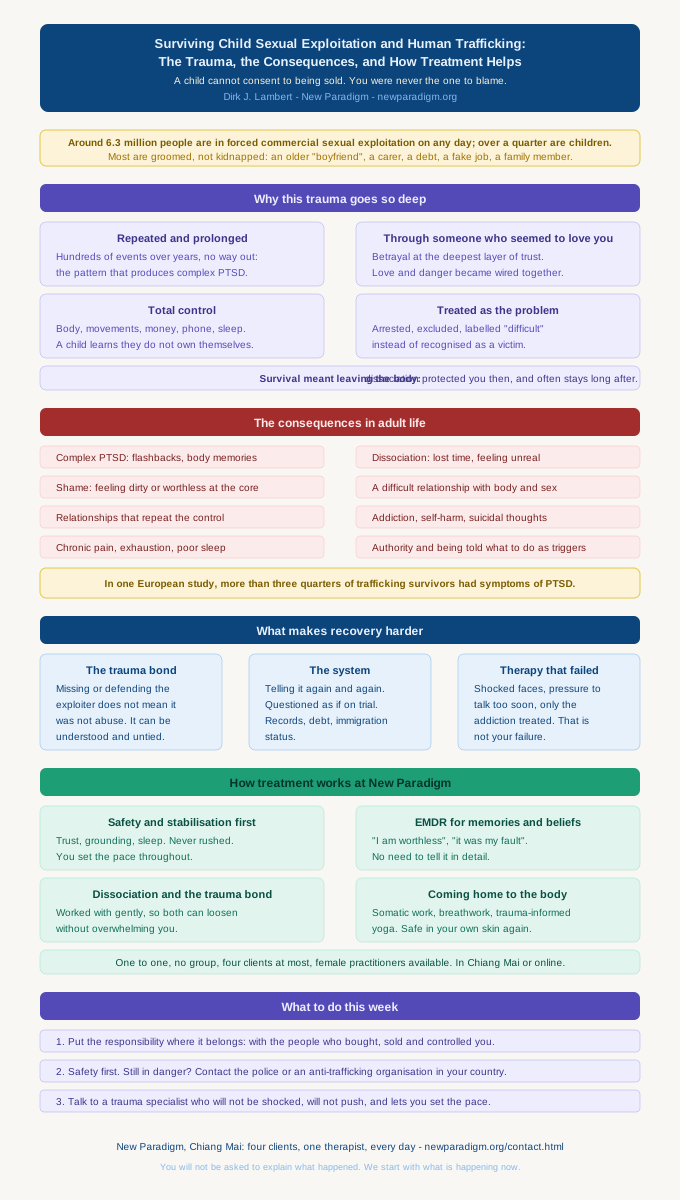
The scale is larger than most people imagine. International estimates suggest that on any given day around 6.3 million people are in forced commercial sexual exploitation worldwide, and more than a quarter of them are children. Many adult survivors of trafficking were first exploited as children.
The routes in are rarely the kidnapping of popular imagination. Most often it is grooming: an older "boyfriend" who offers attention and affection, then gradually creates dependency and debt, a method sometimes called the loverboy method. Sometimes it is a family member. Sometimes it is a peer, a fake job offer, a debt, or the need to survive after running away from a home that was already unsafe. Specialist treatment for survivors of sexual abuse and exploitation starts from the understanding that the child was targeted, often precisely because they were already vulnerable, and that nothing about what followed was their fault.
Why This Trauma Goes So Deep
Every form of sexual abuse leaves a wound. Sexual exploitation and trafficking combine several factors that make the wound especially deep.
- It is repeated and prolonged. Not one event but hundreds, often over years, with no way out. This is exactly the pattern that produces complex PTSD rather than PTSD alone. I have written separately about how complex PTSD differs from PTSD.
- It came through someone who seemed to love you. When the exploiter was first a boyfriend, a carer or a parent, the betrayal reaches into the deepest layer of trust. Love and danger became wired together.
- Control was total. Over your body, your movements, your money, your phone, your sleep, sometimes your documents and your name. A child living under that control learns that they do not own themselves.
- Survival required leaving your own body. To get through what was happening, the mind learned to switch off, go numb, or watch from somewhere else. That dissociation was protective, and it often remains long after the danger is gone.
- You were treated as the problem. Many survivors were arrested, punished, excluded from school or labelled as "promiscuous", "difficult" or "making bad choices" by the very people who should have recognised them as victims.
Research reflects this. In one European study of women and girls in post-trafficking services, more than three quarters had symptoms of PTSD, and around half had symptoms of depression or anxiety. Those numbers do not describe weakness. They describe what happens to any human nervous system under these conditions.
The Consequences in Adult Life
Leaving the situation does not end the trauma. For many survivors the hardest years come afterwards, when there is finally enough safety for what happened to catch up with them. These are the consequences I see most often:
- Complex PTSD. Flashbacks, nightmares and body memories, together with overwhelming emotions, a deeply damaged sense of self, and difficulty in relationships.
- Dissociation. Losing time, feeling unreal, watching yourself from outside, not feeling your body. Sometimes parts of the experience are missing from memory altogether.
- Shame. Not guilt about something you did, but the feeling of being dirty, damaged or worthless at your core. Many survivors also carry intense shame about moments when their body responded, or when they appeared to go along. I have written about the shame that keeps survivors silent and about why children freeze rather than fight.
- A difficult relationship with the body and with sex. Avoiding touch altogether, feeling nothing, or finding that intimacy pulls you straight back into survival mode.
- Relationships that repeat the pattern. Being drawn to partners who control, or keeping everyone at a distance so nobody can get close enough to do it again.
- Addiction. Drugs and alcohol are often introduced by exploiters to create dependency, and later become a way to numb what cannot be borne.
- Self-harm and suicidal thoughts. Common, and a sign of how much pain is being carried, not of attention seeking.
- Physical health problems. Chronic pain, gynaecological problems, sleep disorders and exhaustion, often linked to both the original harm and to a nervous system that never stands down.
- Difficulty with ordinary life. Money, authority, appointments, being told what to do: everyday situations can trigger the old experience of being controlled.
The Trauma Bond: Why It Still Hurts to Think of Them
One of the most confusing parts of recovery for many survivors is that they still have feelings for the person who exploited them. They may miss him, defend him, feel guilty for leaving, or long for the early days when he seemed to care. This is not a sign that it was not really abuse. It is a trauma bond: an attachment created when the same person is the source of both danger and comfort, cruelty and occasional kindness. For a child, the brain will attach to whoever is there, because attachment is survival.
Trauma bonds are one of the reasons it is so hard to leave, and one of the reasons survivors are so often judged, by police, by family, sometimes by themselves. In treatment, the bond is not something to be ashamed of. It is something to be understood and gently untied, so that the longing can be grieved without pulling you back.
What Makes Recovery Harder
Survivors of exploitation and trafficking often meet a series of obstacles when they try to get help. The legal process may require them to describe what happened again and again, and to be questioned as though they were the ones on trial. I have written about how seeking help can cause more pain, and for trafficking survivors that risk is especially high. Immigration status, a criminal record from the time of exploitation, debt and the absence of family support can all add pressure.
Therapy itself can be a hurdle. Many survivors have met professionals who were visibly shocked by their story, who pushed them to talk about details before they were ready, or who treated only the addiction or the depression without seeing what lay beneath. After one or two experiences like that, many people give up. If that has happened to you, it says something about the help you were offered, not about whether you can recover.
How Treatment Works at New Paradigm
Recovery from child sexual exploitation and trafficking is possible. It takes time, care and the right approach, but survivors can and do reach a point where the past no longer runs their present. The work I do follows a careful, phased approach.
Safety and stabilisation first. Before any memory is touched, we build the ground you stand on: a relationship of trust, skills to calm the nervous system, ways to come back when you start to dissociate, and better sleep. For this group, stabilisation is not a formality. It can take time, and it is never rushed. You stay in control of the pace throughout.
EMDR for the memories. EMDR is one of the best-evidenced treatments for trauma. It allows the brain to process memories that were stored as raw threat, so that they become something that happened, in the past, rather than something that keeps happening. It also works on the beliefs attached to those memories: "I am worthless", "I am dirty", "it was my fault". You do not have to talk about your trauma in detail for EMDR to work. For survivors who have been made to tell their story too many times, that matters enormously.
Working with dissociation and the trauma bond. We work gently with the parts of you that learned to switch off, and with the attachment to the exploiter, so that both can loosen without overwhelming you.
Coming home to the body. Somatic work, breathwork and trauma-informed yoga help survivors feel safe in their own bodies again, often for the first time since childhood. Recovery also includes the possibility of safe intimacy, and I have written about healthy relationships after childhood sexual abuse.
The setting is built around safety. Every session is one to one, with no group therapy and no shared disclosure. There are never more than four clients on site, in a private property in the hills outside Chiang Mai. Female practitioners are available for clients who prefer to work with a woman. Everything is confidential, and we hold no records that a third party can request. New Paradigm is an endorsed provider through the Victims of Crime Assistance Tribunal in Melbourne, Australia, and the treatment of sexual abuse survivors has been a central part of my work for more than 25 years.
A word about location. If you were exploited or trafficked in Southeast Asia, coming to Thailand for treatment may not feel right, and that is a valid reason to choose differently. I also work with clients online, so the choice of where to begin is yours.
What to Do This Week
If you recognise yourself in this article, three steps are worth taking now:
- Put the responsibility where it belongs. You were a child, or you were trapped. The people who bought, sold and controlled you are responsible for what happened. Not you.
- Look after your safety today. If you are still in contact with an exploiter, or you are in danger, contact the police or a specialist anti-trafficking organisation in your country first. Therapy comes after safety, not instead of it.
- Talk to a trauma specialist who has worked with this before. Someone who will not be shocked, will not push, and understands dissociation, shame and trauma bonds.
If you are ready for that conversation, contact New Paradigm in confidence. You will not be asked to explain what happened. We will start with what is happening now, and decide together what the right next step is.
About the Author
Dirk J. Lambert is the founder and lead therapist at New Paradigm, a private mental health retreat in Chiang Mai, Thailand. He is a Certified Trauma Specialist (CCTS-I), EMDR practitioner, CBT and NLP specialist, and twice-ordained Buddhist monk with more than 25 years of clinical experience working with complex trauma, PTSD, depression, and attachment disorders. Dirk founded Thailand's first alternative recovery centre in 2000 and established New Paradigm in 2014. He is a recognised specialist in the treatment of sexual abuse survivors, an endorsed provider through the Victims of Crime Assistance Tribunal in Melbourne, Australia, a member of the Complementary Medical Association UK (MCMA), and was named Leading PTSD Innovator in 2026 by Global Health and Pharma. He works personally with every client who enters the programme.